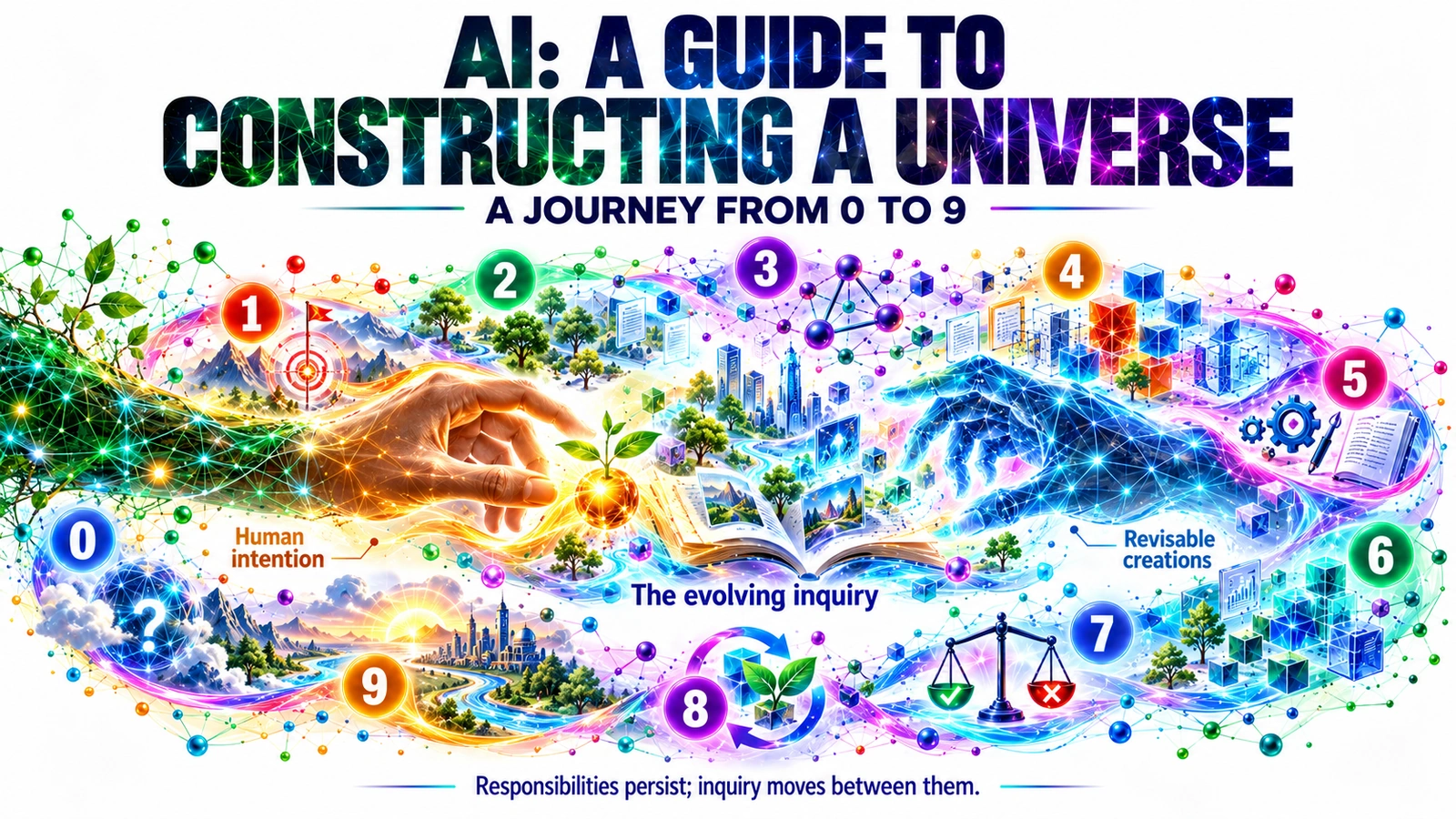
From open possibility to meaningful, grounded, and revisable creations.
Human beings encounter a world they did not make, experience it inwardly, and give that experience outward form. Across cultures, this effort becomes number, geometry, myth, philosophy, science, art, and technology. Could a journey from 0 to 9 help us understand that movement—and the AI systems we now build to participate in it?
Reading the cover
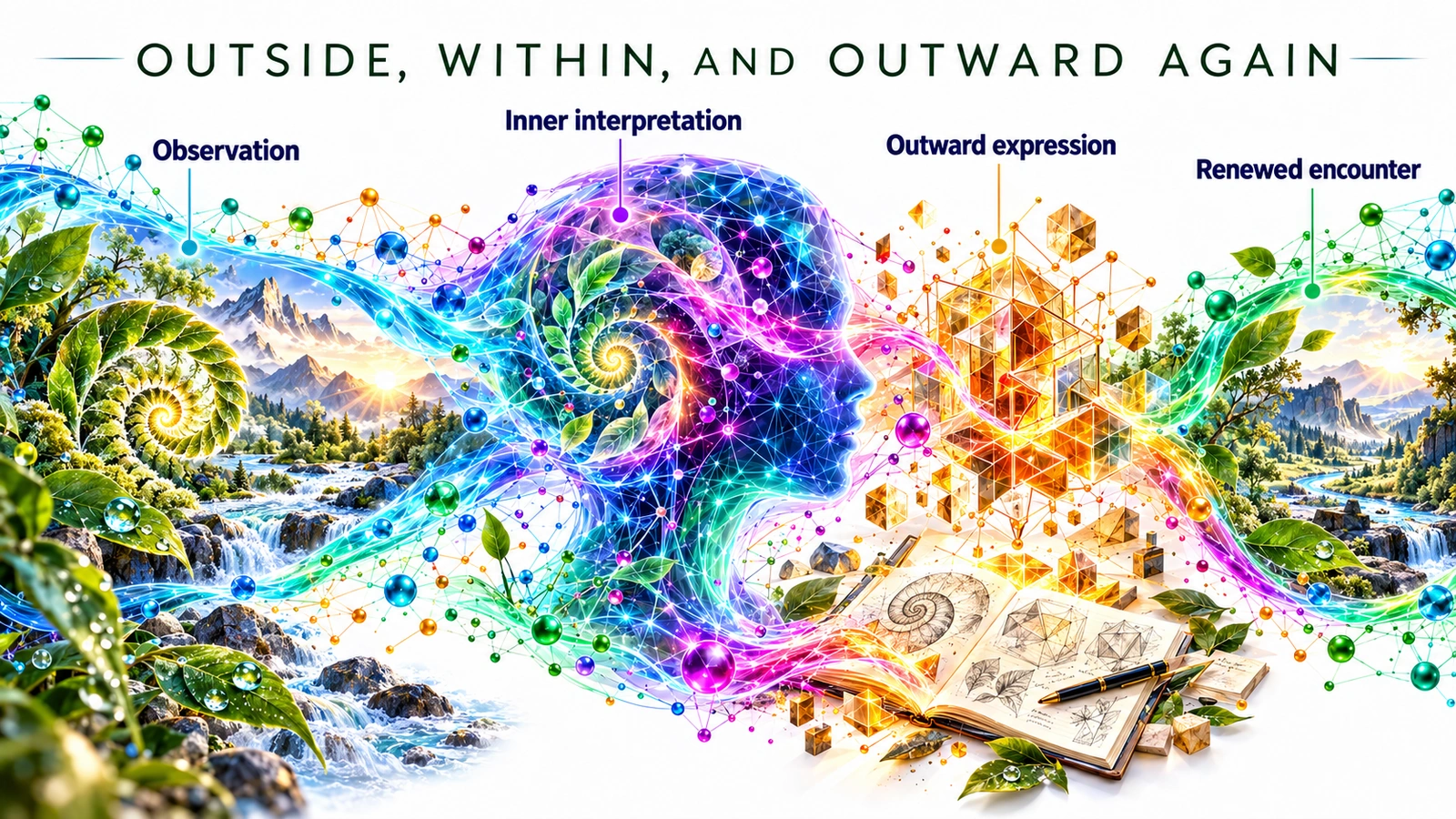
The premise of this essay is that humanity repeatedly attempts to understand three related fields: the reality observed outside, the reality experienced within, and the reality projected outward through action and creation. Nature supplies recurring forms and relationships. Cultures interpret them, preserve them, and sometimes exchange them. AI becomes another creation through which this movement continues.
Our proposal is a visual language of ten persistent responsibilities, numbered 0–9, through which an inquiry can move. It is an architectural and educational interpretation, inspired by symbolic and philosophical sources. Its usefulness depends on whether it clarifies actual work.
The cover compresses the argument into one scene. A human hand and a digital hand surround a world of books, software, buildings, and living forms. They represent collaboration in giving an idea an inspectable form. The luminous connections show an inquiry moving among responsibilities. Ten numbered stations make the responsibilities visible without filling the cover with implementation detail. The deck below expands their meanings, questions and resources.
“Universe” means a world of ideas, models, and realizations. “Ten steps” names a reading journey through that world. In operation, the responsibilities persist: an inquiry can return, branch, pause, or proceed concurrently. The center holds the evolving inquiry, rather than a claim that AI possesses human inner experience.
In this post
- Outside, within, and outward again
- Why number can become a language of qualities
- Inspiration and scope
- From human inquiry to AI architecture
- A universe in ten movements
- What moves, and what persists
- Support across all ten responsibilities
- The inquiry lifecycle
- An intention moving through the architecture
- The macro reflected in the micro
- What this map can help us understand
- References and further reading
Outside, within, and outward again
A seed grows. A river returns to flood. Day gives way to night. A flower displays an arrangement that can be recognized, drawn, compared, and measured.
Human beings observe these events. Observation becomes memory, interpretation, anticipation, and feeling. What was encountered outside acquires significance within. That significance can then become an image, a story, a calendar, a building, an experiment, or a tool. The creation changes what people subsequently encounter and interpret.
This is the movement we want to make visible:
Encounter → interpretation → expression → renewed encounter.

Editorial premise: observation, inner interpretation, and outward creation affect one another. These arrows express our relational model, not a demonstrated mechanism of consciousness.
It is an editorial model, not a complete account of perception. Inner experience also shapes what we notice in the first place. The movement is already reciprocal.
The recurrence of themes across cultures invites investigation. Shared natural conditions and shared human capacities can produce related questions. Cultural transmission can carry an image or practice between communities. Later interpreters can also emphasize resemblance and overlook difference. A circle in two traditions is a starting point for comparison; establishing what it meant in each requires evidence.
Our central question is therefore practical: can the forms through which humanity has understood reality help us make our newest creations more intelligible?
Why number can become a language of qualities
Michael S. Schneider’s A Beginner’s Guide to Constructing the Universe provides a particularly useful bridge. His illustrated exploration moves through numbers 1–10 and their geometric expressions in nature, art, and science. He presents number as carrying recognizable qualities, including unity, polarity, structure, balance, and growth, alongside its quantitative use. See the author’s introduction and the book preview.
For our inquiry, geometry becomes a way to think about relationships. A point can suggest a focus. Two points introduce a relationship. A triangle can help us consider mediation. A square can suggest a bounded structure. Repeating forms make coordination visible.
These are proposed visual meanings. Their value lies in helping a reader remember and examine distinctions. A geometric association does not, by itself, explain an algorithm or establish a law of consciousness.
Schneider’s journey also exposes a choice we must keep explicit: his book explores 1–10, while our architecture uses 0–9. We add 0 as openness to what has not yet been formulated. We retain ten responsibilities without shifting his chapter meanings wholesale or treating 10 as equivalent to 0. The interpretation can change when a better distinction emerges.
Inspiration and scope
Our discussion began with Harry B. Joseph’s The Book of Wisdom and expanded into number, geometry, Hermetic correspondence, Tarot, and Egyptian imagery. These perspectives supplied questions and metaphors for the proposal. The 0–9 responsibility map is our architectural interpretation, inspired especially by Schneider’s exploration of numerical qualities; it is not a shared doctrine attributed to these sources.
Krishnamurti’s emphasis on observation and conditioning encourages us to examine the assumptions behind a map. Bohm’s On Dialogue inspires attention to relationships, shared meaning, and alternative interpretations. For AI, these become practical questions about context, evidence, coordination, and revision. Functional parallels do not establish subjective consciousness; human attention, task focus, and neural attention remain distinct concepts.
The map should help us inspect an inquiry and remain open to change when it obscures the work.
Three complementary questions
The earlier Secret of the Sphinx offered a contemporary symbolic reading of Osiris, Thoth–Sopdet, and Horus. We retain its three questions as lenses across the architecture:
- Transformation: what assumption or arrangement needs to change?
- Awakening: what has become visible or was overlooked?
- Experience: what happens when understanding meets action and consequences?
These lenses can intersect at any responsibility. They add ways to examine the inquiry, rather than additional runtime layers.
From human inquiry to AI architecture
AI is a human creation that participates in interpreting and expressing a world. In systems built to assist inquiry, relevant functions include maintaining context, relating information, selecting actions, inspecting results, and updating a working account.
The premise that AI must “have this movement to imitate us” becomes a design hypothesis: which functions are needed for the particular human activity we want to support? A system helping diagnose a failure needs access to observations, ways to test alternatives, and grounds for a conclusion. A small classifier may need no agent loop at all. Useful imitation of a task does not establish identical inner experience.
Technical work already supplies architectural material for this proposal. Cognitive Architectures for Language Agents, the CoALA paper, organizes language agents around memory, action spaces, and decision-making. Anthropic’s Building Effective Agents distinguishes predefined workflows from agents that dynamically direct their use of tools and describes the combination of models with retrieval, tools, and memory.
Our ten-part map organizes the responsibilities these components may serve. It is not a claim that every AI contains ten native modules.
A component view of the proposal
This overview separates persistent contracts, participating components, and evolving state. The detailed views below unfold the ten responsibilities.
Explore the proposed inquiry architecture

Proposed architecture: responsibility contracts guide agents and components; their work updates inquiry state. Memory and trace preserve continuity. The diagram does not prescribe a centralized store.
A universe in ten movements
Here, a universe is a coherent world of ideas, models, relationships, and realizations that human beings and AI can construct and examine together.
Compare the ten responsibilities
| Number | Persistent responsibility | Guiding question | Possible resources | Actors or roles |
|---|---|---|---|---|
| 0 | Openness | What is unknown or possible? | Open questions, capability registry, limits | Human, explorer |
| 1 | Unity and direction | What are we trying to create? | Goals, instructions, scope, success criteria | Human, clarifier |
| 2 | Relation and context | What does this depend on? | Retrieval, RAG, search, sources, provenance | Researcher |
| 3 | Meaning | How do the ideas connect? | LLM, embeddings, semantic graph, structured representations | Interpreter |
| 4 | Structure | What form and plan will support it? | Schemas, contracts, state machines, workflow plans | Planner |
| 5 | Transformation | What happens when we act? | Tools, APIs, MCP integrations, sandbox, observations | Executor |
| 6 | Organization and integration | How do the parts work together? | Orchestration, evidence links, synthesis, alternative accounts | Coordinator, synthesizer |
| 7 | Discernment | What is supported, uncertain, or missing? | Validators, tests, evaluations, human review | Verifier |
| 8 | Realization and renewal | What can we deliver and improve? | Artifacts, authorized actions, outcome feedback | Producer |
| 9 | Synthesis and horizon | What have we learned; what remains open? | Completion review, revision, next inquiry | Reviewer, human |
AI Inquiry Deck — Ten Persistent Responsibilities
The AI Inquiry Deck expands the ten numbered responsibilities shown on the cover. Each card adds its guiding question, resource vocabulary and actor contribution while retaining a related visual motif. Each list item places its illustrated thumbnail beside the guiding question. Expand the account to explore its function. The numbers identify persistent responsibilities; they are not a required execution order. The role names describe contributions, not ten mandatory agents.
Read the ten responsibilities below; expand any item for resources, actors and limits.
-
 0
0Openness
What is unknown or possible?
Explore details
Before answering, make room for the question. An explorer can identify missing information, propose alternative starting points, and inspect which capabilities are available. Its contribution is a useful account of what could be investigated, including what cannot yet be established. In human experience, this recalls curiosity and the willingness to notice a gap in understanding.
- Resources
- Questions · Capability registry · Limits
- Actors
- Explorer
- Human aspect
- Curiosity and openness to the unknown
- Contribution to the inquiry
- An explicit account of possibilities and unknowns
Limits and revision. A capability registry can list accessible tools; it cannot guarantee that a tool is appropriate or that its output will be true. Openness should preserve uncertainty rather than fill every gap with a plausible story.
-
 1
1Unity & Direction
What are we trying to create?
Explore details
The human and a clarifier turn an initial wish into an intent with scope, constraints, and success criteria. This gives several participants a shared reference for their work. The output might be a brief, an investigation question, or an acceptance contract. The human counterpart is purpose: choosing what matters and accepting responsibility for the choice.
- Resources
- Goals · Instructions · Success criteria
- Actors
- Human + Clarifier
- Human aspect
- Purpose, values, and responsibility
- Contribution to the inquiry
- A revisable intent with scope and success criteria
Limits and revision. Direction remains revisable. Discovering that the requested solution addresses the wrong problem can require a new intent, not merely a better implementation of the original one.
-
 2
2Relation & Context
What does this depend on?
Explore details
A researcher gathers relevant sources, project history, observations, and environmental constraints. Search and retrieval bring material into view; RAG can supply retrieved material to a model's generation context. Provenance records where it came from and, when relevant, when it was observed. The contribution is a situated question rather than an isolated prompt.
- Resources
- RAG · Search · Sources · Provenance
- Actors
- Researcher
- Human aspect
- Relationship, circumstance, and remembered experience
- Contribution to the inquiry
- Relevant context with provenance
Limits and revision. For a person, meaning changes with relationship, circumstances, and remembered experience. In an AI system, context selection is an engineering approximation to part of that function. Retrieved material still needs to be assessed for relevance, freshness, and reliability.
-
 3
3Meaning
How do the ideas connect?
Explore details
An interpreter identifies entities, relationships, ambiguities, and candidate explanations. LLMs can propose interpretations; embeddings can support similarity-based retrieval; a semantic graph can record explicit relationships. These components contribute different operations. Similarity alone does not establish meaning or truth.
- Resources
- LLM · Embeddings · Semantic graph
- Actors
- Interpreter
- Human aspect
- Making sense of experience
- Contribution to the inquiry
- Candidate interpretations and explicit relationships
Limits and revision. This is the semantic emphasis of the map: what does the request mean, which concepts matter, and how might observations relate? The output is an explicit, revisable interpretation. Its human analogue is making sense of experience, with the possibility of misunderstanding still present.
-
 4
4Structure
What form and plan will support it?
Explore details
A planner converts an interpretation into a bounded arrangement of work. Schemas define data shape; contracts define expectations; workflow plans describe steps; state machines represent allowed transitions. A schema can check that a result has a required field without establishing that the field is correct.
- Resources
- Schemas · State machines · Workflow plans
- Actors
- Planner
- Human aspect
- Planning and organizing possibilities
- Contribution to the inquiry
- A bounded plan with inspectable contracts
Limits and revision. The contribution is a plan that can be examined and adjusted. Human planning similarly organizes possibilities into a course of action. Structure supports inquiry when it exposes assumptions and permits revision.
-
 5
5Transformation
What happens when we act?
Explore details
An executor uses tools, APIs, or an MCP connection to inspect or change an environment within granted permissions. A sandbox can bound an experiment. The inquiry gains observations from an action: a command result, a measurement, a changed file, or a failure.
- Resources
- Tools · APIs · MCP · Sandbox
- Actors
- Executor
- Human aspect
- Learning through action and consequences
- Contribution to the inquiry
- Observations from permitted operations
Limits and revision. This is where a proposed explanation meets consequences. Human experience also changes through action, but a successful API call establishes only that an operation succeeded under its reported conditions. Its relevance to the original intent still needs evaluation.
-
 6
6Organization & Integration
How do the parts work together?
Explore details
A coordinator assigns work and manages dependencies. A synthesizer relates the contributions, their sources, and their disagreements. Orchestration can combine deterministic services and agents without making every component autonomous.
- Resources
- Orchestration · Evidence links · Synthesis
- Actors
- Coordinator + Synthesizer
- Human aspect
- Integrating perspectives without erasing disagreement
- Contribution to the inquiry
- A coherent account with evidence and alternatives
Limits and revision. The output is a coherent working account that retains evidence links and alternative explanations. This recalls the human effort to integrate different experiences into a wider picture. Integration should make disagreements inspectable; voting among agents is not a substitute for independent support.
-
 7
7Discernment
What is supported, uncertain, or missing?
Explore details
A verifier checks whether claims and proposed actions meet the inquiry's criteria. Tests, validators, evaluations, and human review contribute different kinds of checks. A test can establish a particular behavior under particular conditions; an evaluation can assess performance on selected cases. Their coverage and limits matter.
- Resources
- Validators · Tests · Evals · Human review
- Actors
- Verifier
- Human aspect
- Judgment about support and uncertainty
- Contribution to the inquiry
- A qualified decision about support, gaps, or revision
Limits and revision. This is the epistemic emphasis: how do we know, and how far does the support extend? Its contribution may be acceptance, rejection, a request for more evidence, or a qualified conclusion. Human discernment likewise includes recognizing when an attractive interpretation exceeds what experience supports.
-
 8
8Realization & Renewal
What can we deliver and improve?
Explore details
A producer gives the supported proposal an explicit form: a report, a patch, a diagram, or another artifact. Actions that change a live environment must respect the authorization for that inquiry. Feedback from use supplies new observations and may reveal a mismatch between the artifact and the intent.
- Resources
- Artifacts · Authorized actions · Feedback
- Actors
- Producer
- Human aspect
- Expression, practical realization, and adjustment
- Contribution to the inquiry
- An inspectable artifact and outcome feedback
Limits and revision. This responsibility makes the result available for inspection and use. Its human analogue is expression and practical realization. Completing an artifact and achieving its intended outcome remain separate questions.
-
 9
9Synthesis & Horizon
What have we learned; what remains open?
Explore details
A reviewer consolidates the account: results, evidence, decisions, limitations, and unresolved questions. Completion review decides whether the inquiry's criteria have been met or whether a bounded stopping point should be recorded.
- Resources
- Completion review · Revision · Next inquiry
- Actors
- Reviewer
- Human aspect
- Reflection, continuity, and a new question
- Contribution to the inquiry
- A consolidated account with limitations and open questions
Limits and revision. This gives future work a grounded starting point. Human reflection can similarly preserve experience while changing the next question. The horizon remains open: 9 can return to 0 with a better question. Recorded feedback provides continuity; it does not automatically retrain the underlying model.
The deck is a conceptual reading aid derived from the cover. Illustrations express responsibilities; they do not report implemented systems or verified results. Every card remains readable without JavaScript, and the same responsibility can be revisited throughout an inquiry.
The responsibilities in two connected views
The two maps share one logical inquiry state. Their relations show possible contributions to that record, rather than a mandatory sequence. A dotted interpretation link indicates that its meaning remains open to examination.

One possible exchange among responsibilities 0–4: orientation and context inform a provisional interpretation and plan. The inquiry record can reopen scope or request context. Responsibilities persist throughout this movement; the path is not mandatory.

One possible interaction among persistent responsibilities 5–9. These edges do not require every investigation to follow this route. Review and consequences can update the inquiry state.
The numeric associations are our interpretation. In particular, assigning discernment to 7 is a design choice, not a claim that Schneider’s chapter establishes an epistemology for AI.
What moves, and what persists
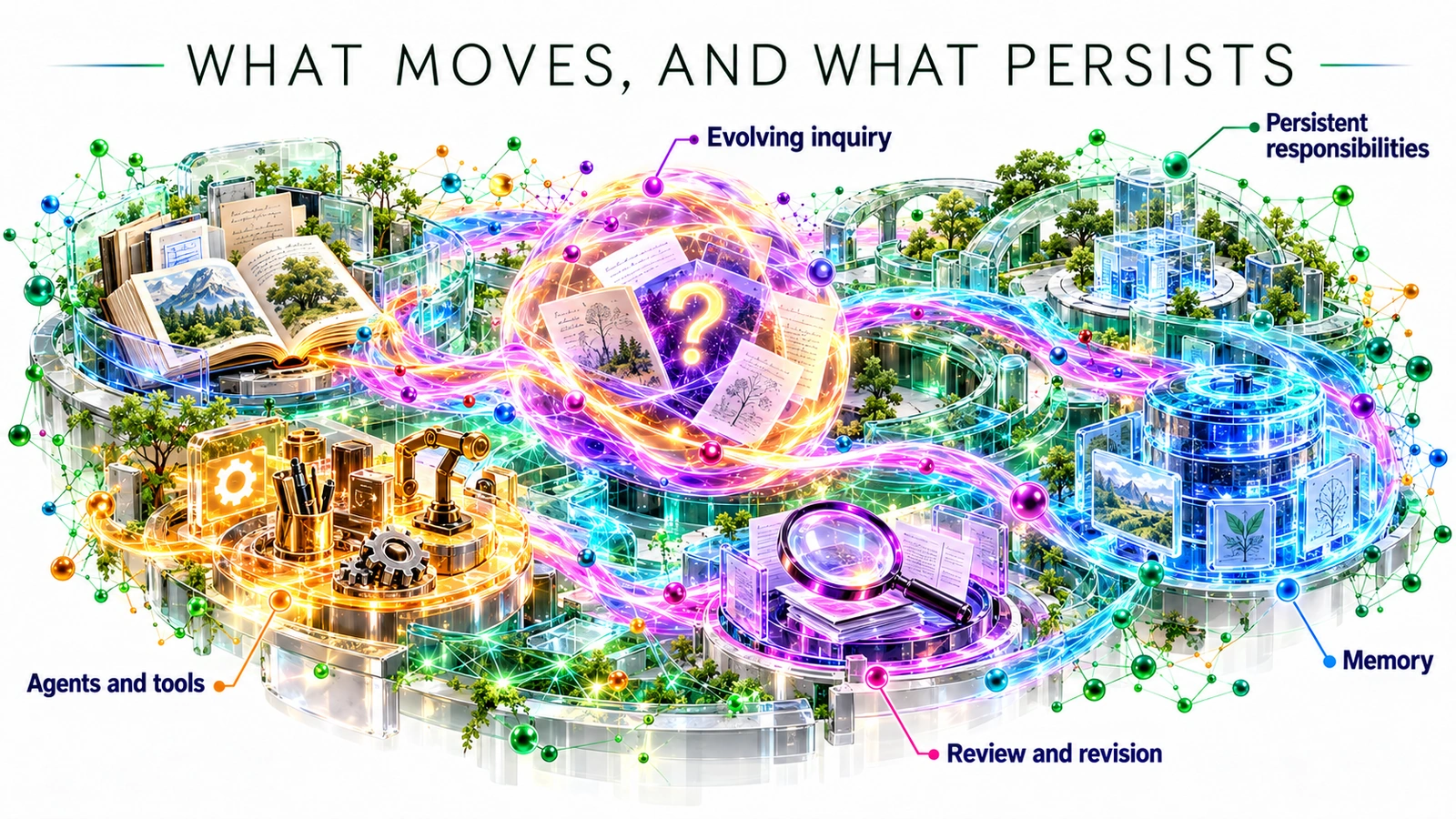
The cover’s central phrase, “the evolving inquiry,” identifies the unit of movement. Responsibilities remain available while the contents and status of that inquiry change.
Three distinct architectural roles
Responsibility
A persistent obligation, such as checking support for a conclusion. It remains available when an inquiry returns or branches.
Participant
A human, agent or component contributes within a scope. One agent can serve several responsibilities; a number does not require a separate agent.
Inquiry state
The evolving account of intention, context, questions, interpretations, evidence, decisions and results.
A component is a concrete mechanism serving a responsibility: a retriever, test runner or schema validator. A transition changes the investigation’s condition when an event or decision justifies it; more evidence may make an account reviewable.
The roles named in the deck are a way to explain contributions. They need not become ten separate agents. One agent may clarify, research, and synthesize; a workflow may use a model for interpretation and deterministic code for validation. Components should be chosen for the inquiry they actually support.
The state carried between responsibilities
| Part of the inquiry | What it should preserve |
|---|---|
| Intention | Desired outcome, scope, constraints, and success criteria |
| Context | Relevant sources, circumstances, and provenance |
| Questions | What needs resolution and what remains unknown |
| Interpretations | Candidate meanings, explanations, and alternatives |
| Evidence | Observations linked to the claims they support or challenge |
| Decisions | Chosen actions, reasons, permissions, and review outcomes |
| Results | Artifacts, consequences, limits, and follow-up questions |
This is a logical view. An implementation can distribute the record among repositories, services, and event logs. A central diagram does not require a single database or sending the entire history to every model call.
Semantics and epistemic responsibility extend across the record. Semantics asks what an account means; epistemic responsibility asks what supports it. Memory supplies continuity, and new experience supplies observations. The numbers emphasize these functions at particular points without giving any one responsibility exclusive ownership.
These are complementary views of the same inquiry, rather than additional numbered layers.
One inquiry, three perspectives
Semantic view
What does the request mean? Preserve relevant entities, concepts and relationships, and keep interpretations revisable as context changes.
Epistemic view
What supports the account? Link observations to claims, retain provenance, and make uncertainties, conflicts and limits inspectable.
Operational view
What may the system do? Coordinate appropriate capabilities, permissions and budgets, then inspect the consequences of actions.
Support across all ten responsibilities
These resources support the entire journey because they sustain more than one responsibility.
| Resource | Contribution across the architecture | Practical limit |
|---|---|---|
| Memory | Retains relevant history, decisions, and unresolved questions | Stored content may be stale or mistaken; retrieval needs context |
| Skills | Supplies reusable procedures, conventions, and review criteria | Procedures need a matching task and remain revisable |
| SDK | Provides APIs for building and coordinating the runtime | Integration does not establish sound reasoning |
| Hooks | Reacts to lifecycle events with checks or other configured behavior | Events and handlers need explicit scope |
| Security | Constrains access, data handling, and permitted actions | Tool availability does not grant authority for every use |
| Observability | Records operations, state changes, costs, and failures | A trace exposes behavior; it does not certify a conclusion |
| Budgets | Bounds time, tokens, cost, retries, and other resources | A budget limit may require a partial result or a pause |
MCP serves the connection between AI applications and external capabilities, as described in the official introduction. Tools and APIs perform concrete operations. RAG supplies retrieved context to generation. The architecture makes their contributions visible instead of treating them as interchangeable forms of intelligence.
The human contributes intention, values, domain judgment, and review. Agents contribute bounded interpretation, coordination, and execution. The hand-to-hand scene on the cover represents this collaboration; responsibility for the system’s design and consequences remains a human concern.
The inquiry lifecycle
An architecture view tells us what responsibilities exist. A state diagram asks a different question: what is the current condition of the investigation, and what would justify changing it?
The numbers on the transitions identify responsibilities commonly mobilized for that movement. They are not state identifiers and do not require each responsibility to execute exactly once.
Explore the inquiry lifecycle and numbered responsibilities

Proposed lifecycle: states describe the inquiry’s condition; numbered transitions name contributing responsibilities. Consolidation preserves limitations and open questions. A pause records why work cannot currently continue.
This view makes stopping and returning as visible as progress. Insufficient evidence calls for further investigation. An unavailable capability may call for narrower scope. A completed artifact can reveal a new problem when its outcome is examined. These changes move the inquiry among persistent responsibilities.
An intention moving through the architecture
Consider a concrete intention: “Help us turn what we observe in a garden into an interactive learning experience about form, relationship, and growth—one that lets visitors distinguish observation, explanation, and symbolic interpretation.”
This brings the post’s central movement into a practical setting: something encountered outside becomes a question, acquires meaning, takes form in a creation, and returns to the world for others to encounter. The human brings curiosity and purpose. AI components help organize the investigation and develop the experience.
At 0 — Openness, the inquiry starts with photographs, sketches, and questions about leaves, flowers, and branching stems. We do not yet know which relationships will be useful or whether an apparent pattern survives closer examination. AI can help articulate questions without turning resemblance into a finding.
At 1 — Unity and direction, the human gives the inquiry a center: help visitors learn how to observe and compare forms. Success means that a visitor can distinguish what was seen, what was inferred, and what was imagined. The coordinator records that intention, the audience, and the limits of the project.
At 2 — Relation and context, a research agent brings together the garden records, relevant botanical sources, and examples of geometric representation. Retrieval and memory preserve where each item came from. The inquiry also records what the photographs leave out: scale, viewpoint, and variation between specimens.
At 3 — Meaning, an interpretation agent proposes ways to understand and present the material: a branching structure, a recurring arrangement, or a visual metaphor for growth. A flower’s appearance, a mathematical model, and a symbolic reading receive distinct labels. A resemblance suggests a question; it does not establish a universal law.
At 4 — Structure, a planner turns those distinctions into a small experience: visitors inspect a specimen, compare it with a drawing, explore a model, and compose their own interpretation. Components receive concrete tasks—organize sources, build the comparison interface, check claims, and review the result. The numbers describe responsibilities; they do not require ten separate agents.
At 5 — Transformation, authorized tools produce a working prototype from the plan: an annotated photograph, an interactive branching model, and a space for a visitor’s interpretation. Skills guide the work; tool interfaces provide the required capabilities. The mathematical model is identified as a model, and the symbolic composition as an interpretation.
At 6 — Organization and integration, an integration component connects each visual element to its explanation, source, and question. The evolving inquiry state now links the original intention, observations, candidate meanings, design decisions, and prototype. What belongs together becomes navigable without erasing their differences.
At 7 — Discernment, reviewers check whether the explanatory claims have support and whether the experience communicates its distinctions. People try the prototype. If they mistake a generated pattern for a measured property of the specimen, that observation sends the inquiry back to meaning, structure, or creation. Attractive output alone does not satisfy the intention.
At 8 — Realization and renewal, the reviewed experience is made available for its intended audience. Visitors encounter the creation and contribute new questions and interpretations. Their responses become observations for a further inquiry: realization changes the world the project next encounters.
At 9 — Synthesis and horizon, memory preserves the sources, decisions, supported explanations, feedback, and unresolved questions. The team can ask which distinctions helped people learn and what needs another investigation. A new specimen or a visitor’s unexpected question can reopen 0, while the responsibilities remain available.
The movement is reciprocal. A difficulty at 7 can revise 3; a missing source can return the inquiry to 2; a response at 8 can reshape the intention at 1. What moves is the inquiry state, not the architectural layers.
Explore the garden-to-learning inquiry sequence

Illustrative garden-to-learning inquiry: numbered contributions can recur. The verifier assists review; the human decides readiness. This diagram describes a proposed interaction, not an observed implementation.
What changed in the inquiry?
| Moment | State update | Consequence for the next contribution |
|---|---|---|
| Curiosity given direction | Audience, learning intention, and review criteria become explicit | Research can focus on what visitors should learn to distinguish |
| Garden records examined | Images and sources acquire provenance and limits | Interpretations remain connected to what was actually observed |
| Meanings proposed | Observation, explanation, model, and metaphor receive distinct labels | Planning can give each an appropriate place in the experience |
| Prototype assembled | Design decisions become an experience people can try | Review can examine both claims and visitor understanding |
| Feedback considered | Confusion, useful comparisons, and open questions enter the account | Meaning, structure, or sources can be revisited |
| Experience made available | The creation becomes part of what others encounter | New observations and questions can reshape the inquiry |
| Learning consolidated | Sources, decisions, feedback, and limitations persist | A subsequent inquiry can build on the work while reconsidering its assumptions |
These are proposed state changes, not reported findings or visitor-test results. The team may discover that a specimen does not support the chosen model, or that a different presentation better serves the intention. AI helps make those revisions possible; human interpretation, judgment, and experience remain part of the inquiry.
The ten numbers organize our reading. The runtime needs suitable transitions, capabilities, and checks for the case at hand. It does not need to march through every number exactly once.
Evidence is a relationship, not a decoration
A measured result becomes evidence when it bears on a particular claim. This smaller map makes the epistemic distinction explicit.
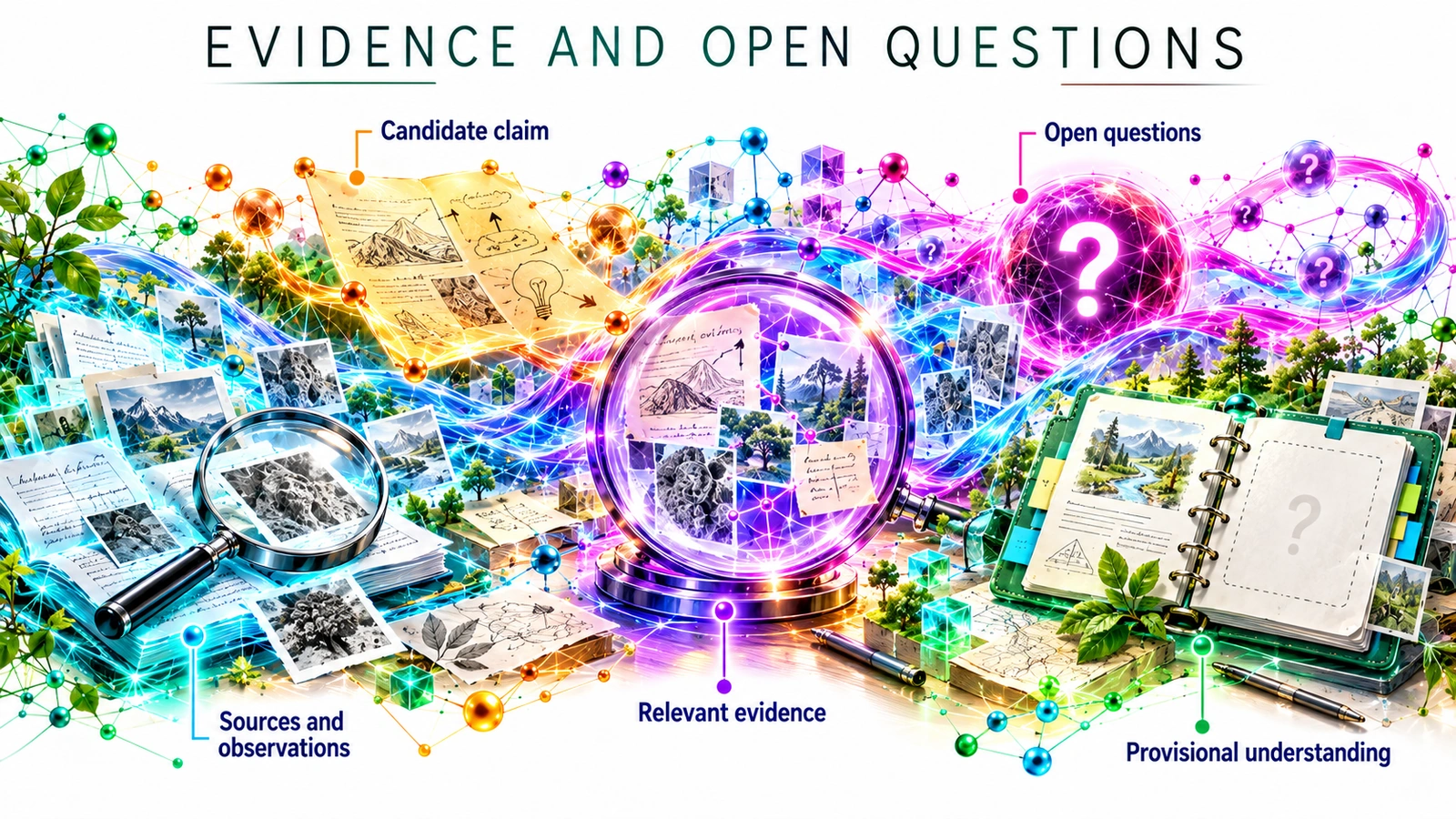

Epistemic distinction: a source yields observations; relevant observations may serve as evidence for or against a claim. Incomplete support keeps inquiry open. Solid arrows show modeled relations; the dotted edge marks unresolved inquiry.
The macro reflected in the micro
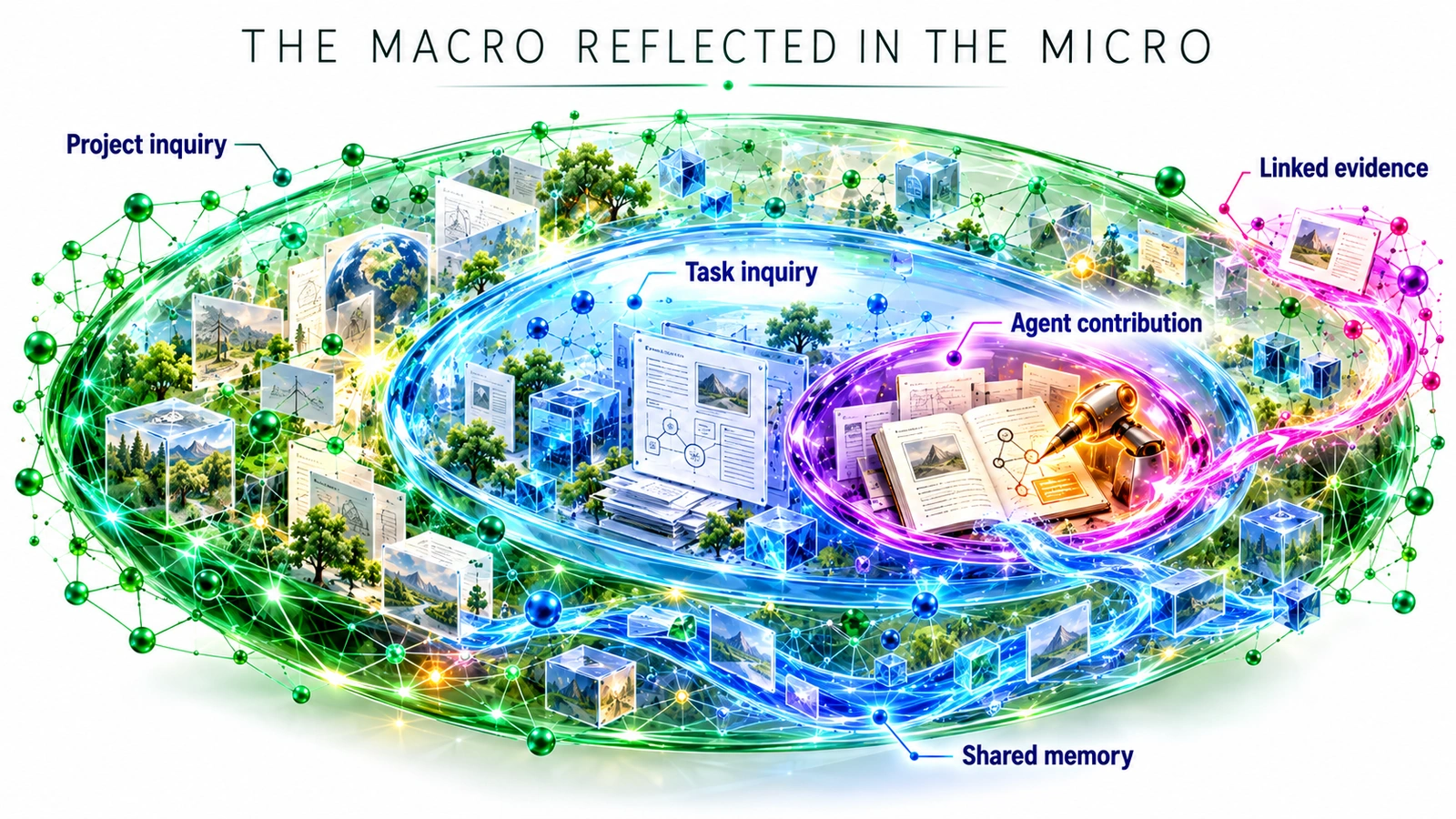
A project can contain smaller investigations with related responsibilities. Creating the garden learning experience may require a smaller inquiry into whether a particular specimen supports a chosen geometric model. That inquiry has its own goal, context, candidate interpretations, observations, evaluation, and result. Its conclusion informs the larger experience; it does not determine the meaning of the whole project.
This is a concrete architectural use of the macro–micro analogy: a similar responsibility pattern may recur at different scopes. The smaller result should remain connected to its evidence and to the larger question it helps answer. Whether every inquiry needs all ten distinctions is itself testable.
Memory is continuity here. Preserving observations, decisions, and unresolved questions can help future work. Recording feedback does not automatically retrain a model, and agreement among several agents does not independently validate their shared conclusion.
Semantics concerns what an account means: the entities, relations, concepts, and intended outcome. Epistemic responsibility concerns what supports that account: sources, uncertainty, contradictions, tests, and limits. Both extend across the inquiry.
What this map can help us understand
The proposal can serve three purposes: teach how AI components contribute to a whole, guide the allocation of responsibilities, and expose the movement of an investigation in an interface or trace.
It can also prompt human reflection. What shaped my interpretation? What evidence am I missing? Am I defending a conclusion because I prefer it? What did the consequences reveal? These questions remain open to experience; assigning them a number does not exhaust them.
The practical test is whether the map helps people distinguish a retrieved source from a claim, a proposed action from an authorized action, an executed tool call from a supported conclusion, and a completed artifact from a completed inquiry.
A useful architecture can represent missing context, uncertainty, contradiction, failure, and a decision to stop. If the ten-step image makes every journey look successful, it needs revision.
Humanity looks outward, feels and interprets inwardly, and gives outward form to what it understands. AI participates in that continuing effort as a creation we can shape, inspect, and revise. The value of our map lies in making that participation more intelligible—and in leaving room for what the map has not yet helped us see.
References and further reading
Symbolism and number
- Harry B. Joseph / Revival of Wisdom: official platform, the contemporary starting point for our discussion.
- Michael S. Schneider: A Beginner’s Guide to Constructing the Universe—author’s introduction; book preview and contents.
Observation and shared meaning
- J. Krishnamurti: The Core of the Teachings, written in 1980.
- David Bohm: On Dialogue.
AI architecture
- Sumers et al.: Cognitive Architectures for Language Agents.
- Anthropic: Building Effective Agents.
- Model Context Protocol: official introduction.
Related explorations
Source note: the ten responsibilities and symbolic bridges are editorial interpretations. Technical sources support the described architectural functions, rather than the number assignments.