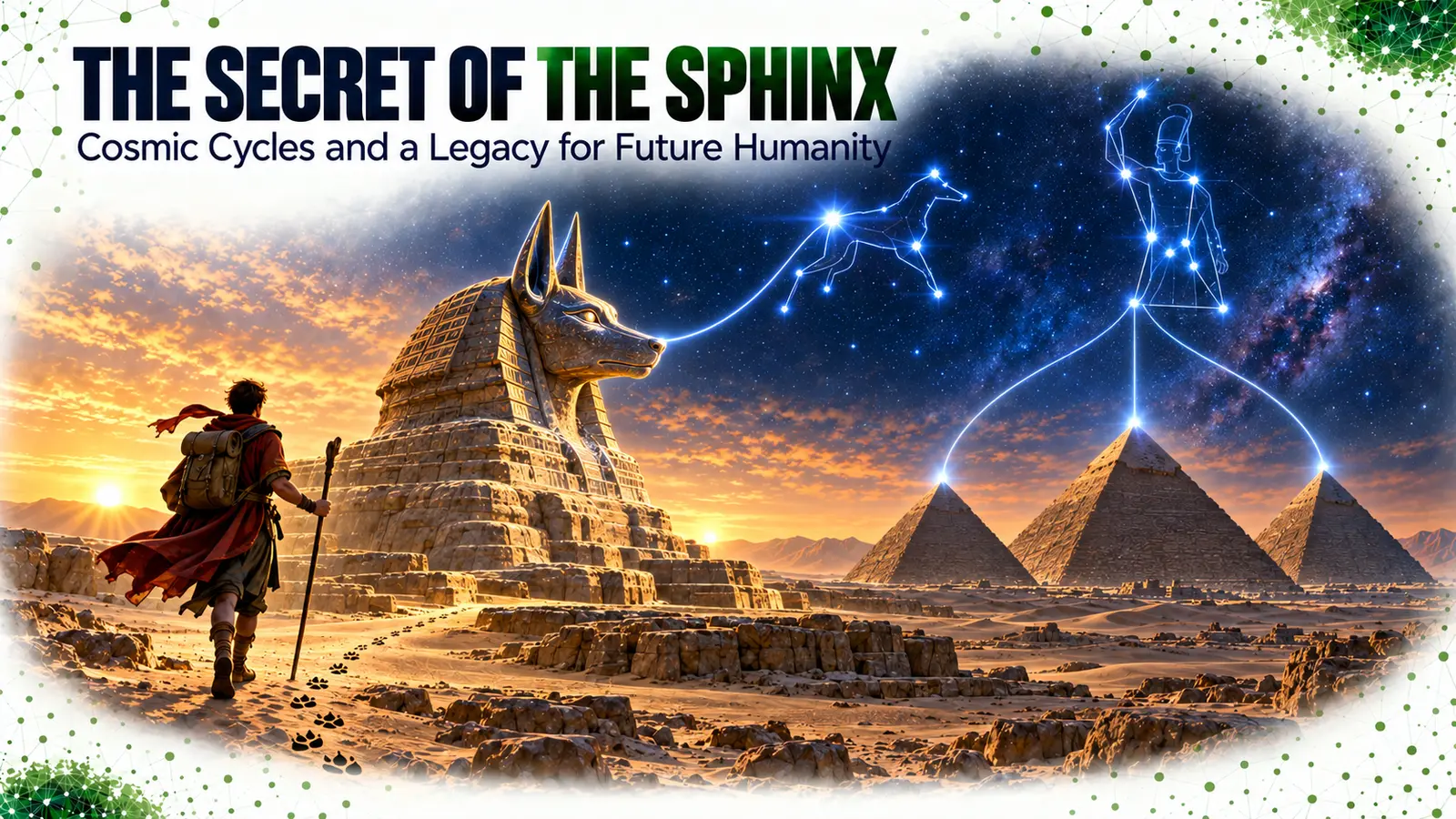
Some monuments appear to preserve a memory larger than the civilization that built them.
The Great Sphinx may be one of them.
This does not mean that every symbolic connection surrounding it is established history. What follows is a visual interpretation: an attempt to understand the Sphinx as a compass linking natural cycles, celestial observation and humanity’s recurring need to find its way again.
At a Glance
This article explores one question: could the Sphinx, the pyramids and the surrounding celestial symbols be read as a mnemonic compass for humanity after a civilizational rupture?
It follows four layers:
- Natural cycles — day and night, the seasons and the Great Year.
- Celestial signs — Sirius, Orion and the Egyptian associations of Horus, Thoth, Sopdet, Osiris and Anubis.
- Monumental correspondences — the pyramids and Sphinx as a proposed reflection of those cycles.
- A message for the future — the traveler as an image of humanity recovering its bearings.
The astronomical facts and historical sources provide anchors for the discussion. The connections between them, including the proposed Anubis-headed Sphinx and the Sphinx-to-pyramids journey, are interpretive rather than established archaeological conclusions. The intended result is not a proof of a hidden system, but a clearly bounded symbolic reading that readers can examine, question and carry forward.
Contents
- At a Glance
- As Above, So Below
- The Three Cycles
- The Three Cycles as Stages of Consciousness
- Sirius: A Sign of Return
- When the Traveler Loses the Way
- The Sky Becomes a Compass
- The Traveler, Zero and Twenty-Two
- The Great Year
- A Legacy for Future Humanity
- References and Further Reading
As Above, So Below
The familiar expression as above, so below conveys a simple idea: life on Earth can be understood by observing patterns in the sky.
For ancient societies, this was practical knowledge. The return of daylight, the movement of the seasons and the reappearance of particular stars helped people decide when to travel, cultivate the land and prepare for change.
A repeating pattern offers more than order. Once recognized, it offers foresight.
To recognize a cycle is to prepare for its return.
The Three Cycles
We experience some cycles directly and others only through accumulated memory.
- Day and night form a cycle we live every day.
- The seasons form a cycle we remember from year to year.
- The Great Year is so long that no individual can witness it in full.
The first two cycles are obvious. The third raises a more difficult question: could civilizations also pass through long seasons of emergence, flourishing, decline and renewal?
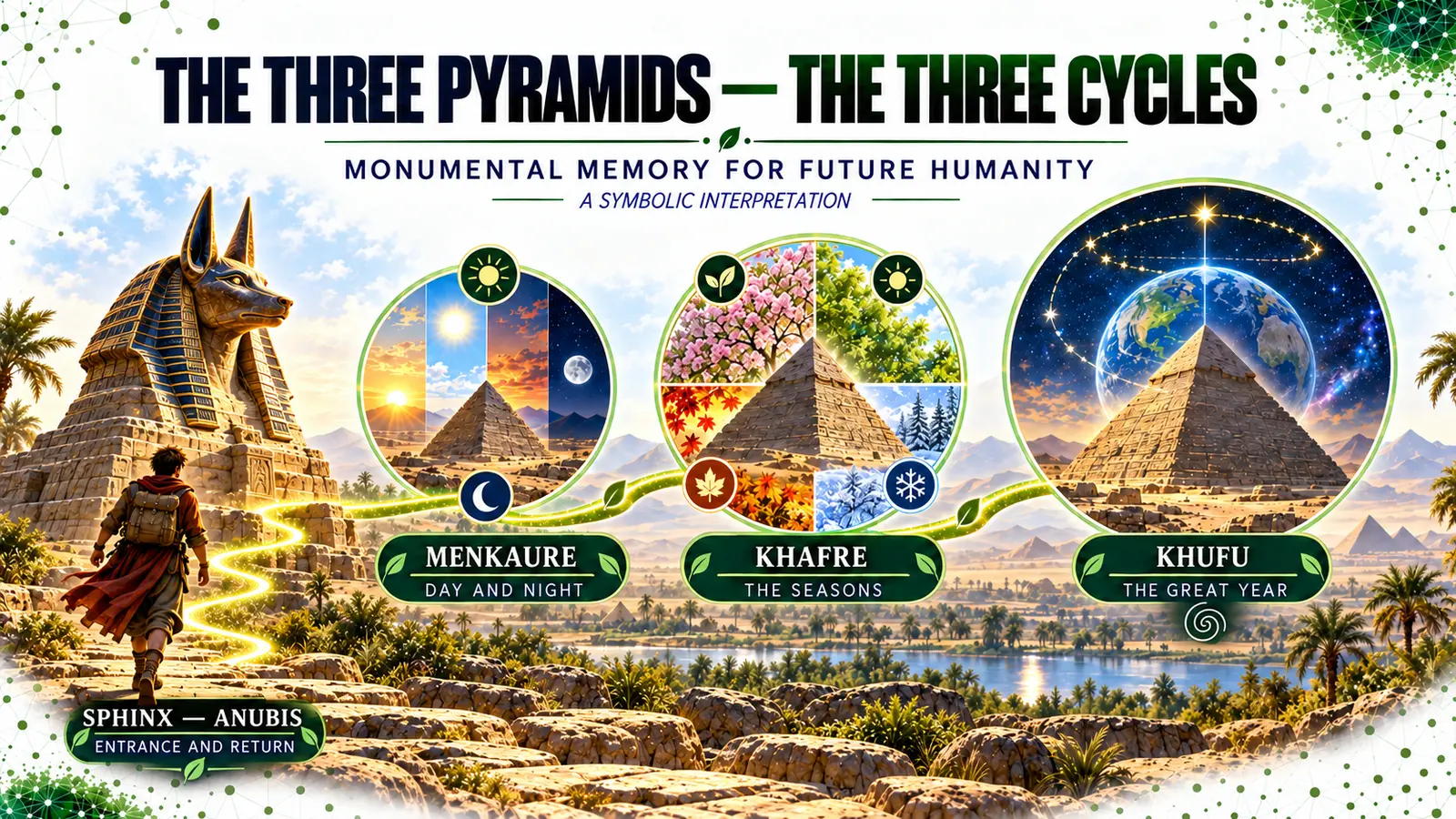
Within the symbolic reading explored here, the three pyramids give these cycles a durable form:
- Menkaure, the smallest, represents day and night, with Horus as its symbolic figure—the cycle closest to human experience.
- Khafre, the intermediate pyramid, represents the seasons, with Thoth–Sopdet as its symbolic figures—the cycle that organizes life across the year and returns with Sirius.
- Khufu, the largest, represents the Great Year, with Osiris–Orion as its symbolic figure—a cycle so vast that only civilizations, traditions and monuments could carry its memory.
This is a proposed symbolic correspondence, not an established function assigned to the pyramids by archaeology. Its internal logic comes from scale: as the monuments grow, so does the duration of the cycle they preserve. The figures form a second dimension of the mapping: Horus marks daily experience and renewal, Thoth–Sopdet marks awakening and seasonal return, and Osiris–Orion marks the long cycle of transformation, memory and rebirth.
For a related audiovisual exploration of pyramid chronology and symbolism, see The Pyramid Code: A New Chronology. It is included as complementary material for the interpretive layer of this article, not as evidence of an accepted archaeological chronology.
The Three Cycles as Stages of Consciousness
The same three-cycle structure can also be read inwardly. In this interpretation, the pyramids do not only preserve different measures of time; they describe the widening field of human awareness. This is a symbolic layer of the article, not a claim that ancient Egyptian sources defined these cycles as a psychology of consciousness.
The First Cycle: The Initiate
The Daily Cycle begins with experience at the human scale. The central archetype is the Initiate: a consciousness beginning to recognize conflict, desire, separation and identity.
Its question is:
Who am I?
This is the cycle of immediate experience, where the individual first encounters the boundaries of the self and begins to distinguish inner life from the surrounding world.
The Second Cycle: Life and Transformation
The Annual Cycle widens awareness beyond the isolated ego. Its themes are death, renewal, nature, wisdom and integration. The mind begins to perceive impermanence and continuous transformation through the rhythm of the seasons, the Nile and the return of Sirius.
This is the cycle of dying and becoming again. Nature becomes a teacher: what disappears may return in another form, and renewal is not a rejection of death but part of its pattern.
The Third Cycle: Collective Consciousness
The Great Cycle extends the field of awareness from the individual to humanity as a whole. Its themes are unity, transcendence, collective consciousness and integration.
Here, the individual begins to understand humanity as a single living process moving through eras and civilizations. The question is no longer only “Who am I?” but also:
What are we becoming together?
The Great Year therefore represents more than an immense astronomical interval. Within this symbolic reading, it is the cycle in which consciousness recognizes that it is not separate from the whole and begins to imagine a future beyond the limits of one life, one culture or one civilization.
Sirius: A Sign of Return
Sirius is the brightest star in the night sky and belongs to Canis Major, the Great Dog. Its heliacal rising—its first visible appearance shortly before sunrise after a period of absence—became an important seasonal marker in ancient Egypt.
The star did not create the cycle. It made the cycle visible.
This is why Sirius works so well within the story of orientation. It is bright, recognizable and connected with return. In later Greco-Roman tradition, its place in Canis Major gave it the familiar name the Dog Star.
Orion offers another celestial figure. In Egyptian religious imagination, Orion was associated with Osiris. Seen together, Orion and Canis Major create the suggestive image of a great figure followed by a celestial dog.
Within the composition proposed here, Sirius gives the seasonal cycle its celestial figure: Sopdet, the Egyptian personification of Sirius. Thoth adds the principle of awakened perception, language and knowledge. Together they form the symbolic pair Thoth–Sopdet for the middle pyramid: the annual return of the star becomes a moment of awakening and recognition.
When the Traveler Loses the Way
Imagine a traveler lost in the desert. The landscape no longer provides a clear direction. Yet the tracks of a jackal may reveal a route invisible to the traveler, because the animal knows how to move through that territory.
This gives Anubis a powerful symbolic role. In funerary papyri such as the Papyrus of Hunefer, Anubis appears at the beginning of a decisive passage. That iconography establishes his association with thresholds, but it should not be transferred literally to the landscape proposed here.
In this interpretation, Anubis is not a separate figure walking beside the traveler. Anubis is the Sphinx itself: the stationary threshold that marks both entrance and return. The traveler reaches the Sphinx alone. From there, the path through the three pyramids—and the three cycles they preserve—begins.
Robert and Olivia Temple develop a related modern thesis in The Sphinx Mystery: The Forgotten Origins of the Sanctuary of Anubis: that the Sphinx was originally carved as a monumental Anubis and stood within a water-filled enclosure associated with the “Jackal Lake” of the Pyramid Texts. This is a relevant reference for the Anubis-Sphinx interpretation developed here, but it should be treated as the Temples’ hypothesis rather than as settled archaeological consensus.
After a catastrophe, humanity would face the same problem as the lost traveler. The old paths would have disappeared. The survivors would need signs capable of restoring orientation.
The Sky Becomes a Compass
What if the celestial pattern—and the knowledge of its cycles—had been given a monumental reflection on Earth?
Above, Orion can be imagined as Osiris, accompanied by Canis Major and its brilliant star Sirius. Below, the three pyramids form a terrestrial correspondence: Menkaure/Horus for day and night, Khafre/Thoth–Sopdet for the seasons, and Khufu/Osiris–Orion for the Great Year. The Sphinx—reimagined here with the head of Anubis—becomes the threshold through which the traveler enters and leaves this path of cycles.
This is not an established archaeological reconstruction. The surviving Sphinx has a human head and a lion’s body, and the identification proposed here remains symbolic.
Herodotus nevertheless preserves an important clue. In Book II of the Histories, he describes the monumental causeway, underground chambers cut into the plateau and a Nile-fed channel associated with the Great Pyramid’s subterranean chamber. He does not state that a tunnel connected the Sphinx to the three pyramids. Within this article, his account therefore serves as evidence that passages and subterranean works belonged to the remembered landscape—not as proof of the complete Sphinx-to-pyramids route proposed here.
Its value lies in the question it asks:
Could the monuments function as a compass, reminding future humanity to look upward, recognize the cycles and recover its place within them?
The Traveler, Zero and Twenty-Two
The Tarot Fool provides a later visual parallel. Traditionally numbered 0, and sometimes placed conceptually after 21 as the traveler who begins again, the Fool stands both before the journey and beyond its completion.
The small dog accompanying the traveler can be read as instinct, warning and guidance. It should not be treated as evidence of an Egyptian origin for Tarot. Here it serves as an analogy.
The traveler represents humanity. The Sphinx–Anubis represents the entrance and exit of the path. When a civilization loses its direction, it must recover a degree of innocence, freedom and openness before a new journey can begin.
Within the symbolic framework proposed here, the twenty-two-card journey of the Major Arcana can also be read through three Egyptian symbolic paths: Osiris, Thoth–Sopdet and Horus. This is not evidence that ancient Egypt possessed a Tarot system divided into three official paths. It is a later interpretive overlay that gives the Fool’s journey a distinctly Egyptian rhythm.
The three paths can be understood here as three interpretive arcs within one cycle:
- The path of Osiris is transformation through descent, loss, death and the hidden world. It preserves the memory of what has been broken and asks what must be recovered.
- The path of Thoth–Sopdet is awakening through knowledge, observation and seasonal return. It joins the intelligence that interprets signs with the star that makes the annual cycle visible.
- The path of Horus is experience, return, rightful vision and renewed order. It represents the living figure who confronts disorder and carries the recovered knowledge into the future.
The three pyramids become the monumental counterpart of these arcs. The recovered composition reads Khufu as the Path of Transformation, represented by Osiris–Orion and the Great Cycle; Khafre as the Path of Awakening, represented by Thoth–Sopdet and the Annual Cycle; and Menkaure as the Path of Experience, represented by Horus and the Daily Cycle. This is not a claim that the pyramids were historically dedicated to those figures in this arrangement. It is a symbolic reading of the Giza plateau as a landscape in which transformation, awakening and experience correspond to the Great Year, the seasons and day and night.
The traveler therefore crosses one order at several scales: the Sphinx–Anubis is the threshold, the three pyramids are the terrestrial paths, and Orion, Sirius and their divine figures form the celestial pattern above them.
Read this way, the Fool is not merely beginning a linear sequence. The Sphinx–Anubis and the Fool do not require a path of their own because their function is to permit passage between all three paths. The Fool can therefore stand at 0 at the entrance and, in the symbolic 0/22 reading, at 22 when the cycle closes and begins again. The threshold is both entrance and exit: it leads into transformation, awakening and experience, then receives the traveler again when the Great Cycle turns.
The Great Year
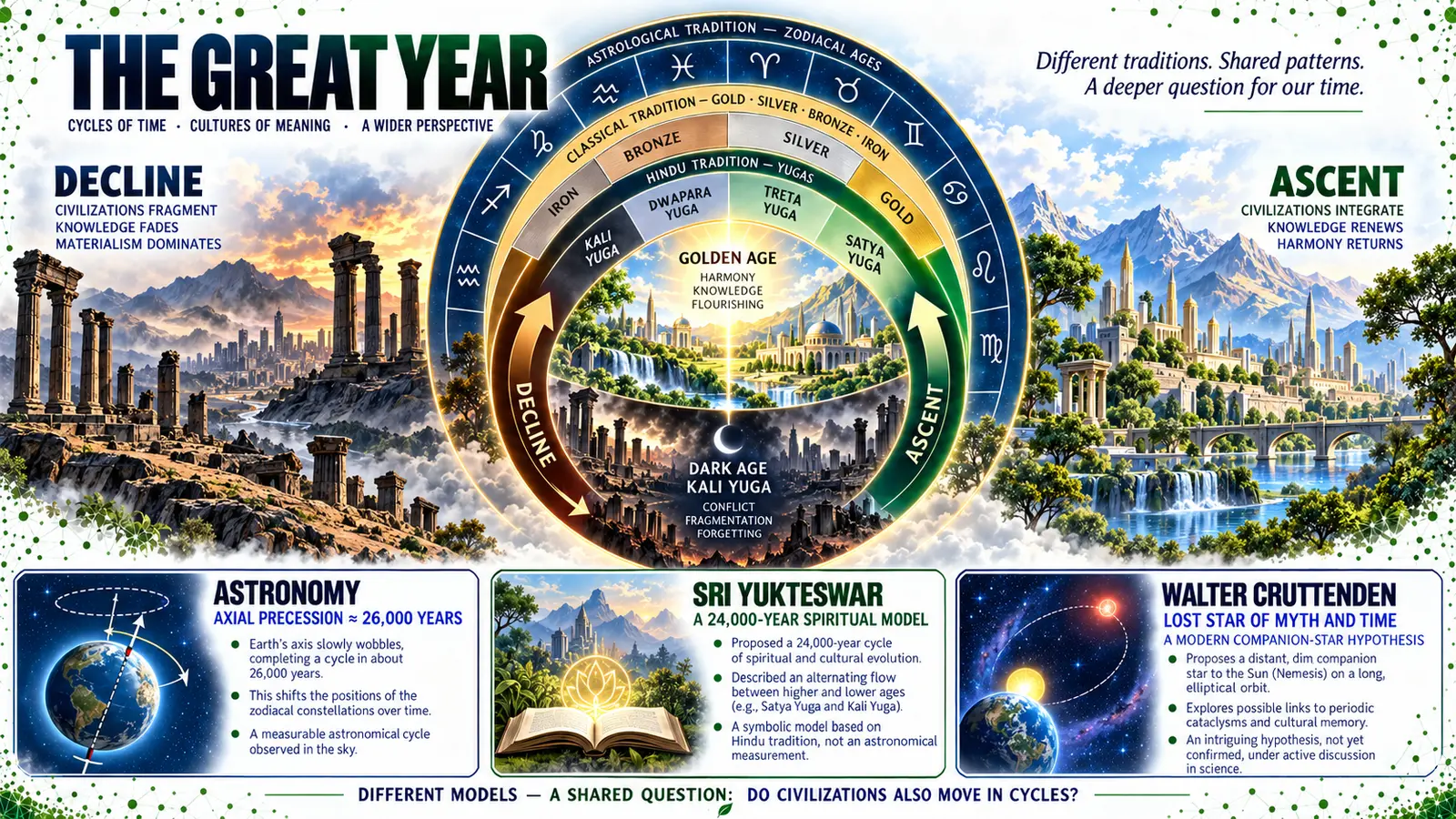
Modern astronomy describes axial precession: the slow change in the direction of Earth’s rotational axis, completing a cycle in approximately 26,000 years. Ancient and spiritual traditions developed their own, distinct models of long ages.
The Hindu Yugas, the classical ages of gold, silver, bronze and iron, and the astrological ages should not be treated as identical systems. Yet they share a compelling intuition: history may move through rhythms larger than a human lifetime.
Sri Yukteswar presented a spiritual model of a 24,000-year ascending and descending cycle. Within the traditional Yuga language, Kali Yuga represents the darkest phase—a period associated with material limitation, fragmentation and diminished awareness.
Walter Cruttenden revisits these questions in Lost Star of Myth and Time. His work examines the Great Year, recurring ages and a proposed astronomical explanation involving a companion-star hypothesis. That explanation is not accepted astronomical consensus, but the book remains a useful modern reference for the interpretive tradition explored here. The linked video is included as a visual reference for this symbolic layer, not as evidence for the astronomical measurement of axial precession.
The distinction matters:
- Astronomy describes the measurable precession of Earth’s axis.
- Traditional systems give spiritual and cultural meaning to long ages.
- Cruttenden’s model is a modern hypothesis seeking a physical explanation for recurring ages.
They are related within this narrative, but they are not the same claim.
A Legacy for Future Humanity
Why build on such an immense scale?
Perhaps a monument intended to speak across civilizational cycles could not depend on fragile books, institutions or languages. It would need to survive abandonment, environmental change and even catastrophe. Its scale would not be an excess: it would be part of the message.
In this interpretation, the pyramids are monumental because the knowledge entrusted to them must outlive the world that built them. Day and night can be rediscovered in a single day. The seasons require a year. But the Great Year requires a legacy capable of crossing ages.
The traveler approaching them is therefore not merely a person lost in the desert. The traveler is future humanity, arriving after rupture or catastrophe and searching for the signs that will make the world intelligible again.
Perhaps the immense scale of these monuments—built to endure when almost everything else would disappear—was justified by this purpose. They may have been intended to help humanity rediscover its bearings amid the rise and fall of civilizations.
When the world loses its way, the monument points upward: observe the cycles. Then it points back to Earth: recognize their reflection.
Perhaps this was the legacy intended for the people of the future—not a collection of answers, but a compass through time.
References and Further Reading
- NASA — Milankovitch Cycles and axial precession
- NASA — Nutation and Precession
- Papyrus of Hunefer — Anubis guiding the deceased
- Herodotus, Histories, Book II.127
- Robert and Olivia Temple, The Sphinx Mystery: The Forgotten Origins of the Sanctuary of Anubis — a modern hypothesis about the Sphinx’s original identity as Anubis and its relationship to the Giza monuments.
- Encyclopaedia Britannica — Osiris — background on the Osirian mythic cycle and its Egyptian context.
- The Great Year — video reference — a visual reference for the Great Year and its symbolic interpretation.
- The Pyramid Code Documentary — an audiovisual reference for the pyramids, ancient Egypt and their symbolic interpretation; included as complementary material, not as archaeological or astronomical proof.
- Walter Cruttenden — Lost Star of Myth and Time
The astronomical, historical and symbolic layers in this article are deliberately distinguished. The proposed Anubis-headed Sphinx and its celestial correspondence form an interpretive framework rather than an established archaeological conclusion.