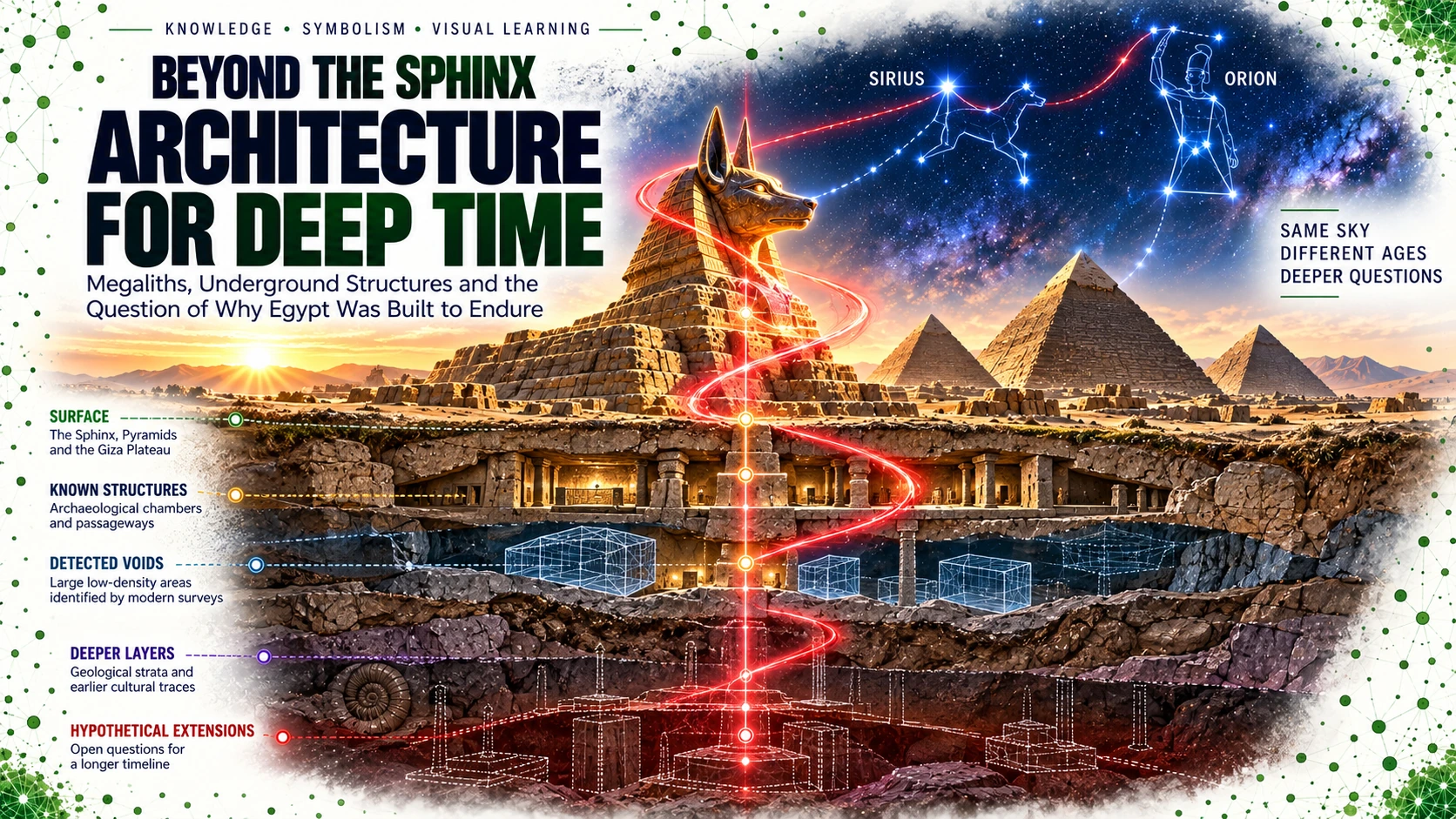
Shout out: To researchers, archaeologists, and independent thinkers who keep exploring Egypt with rigor and imagination — reminding us that the past is not a closed book, but a deeper conversation with time.
Perhaps the mystery is not what Egypt wanted to tell us, but why it built as if time itself were part of the audience.
Some monuments are made for a generation.
Others are made for a dynasty.
And then there are structures whose scale, material and mass seem to belong to a different category altogether: architecture that can survive the disappearance of the people who built it.
The pyramids of Giza are still here after roughly four and a half millennia. The Osireion at Abydos still holds its monumental stone architecture below ground. At Hawara, little remains above the surface of the temple complex that ancient authors called the Labyrinth, yet archaeology and geophysics continue to recover traces of what once stood there.
This article begins where The Secret of the Sphinx ended.
That earlier journey asked whether the Sphinx and pyramids could be read symbolically as a compass carried across civilizational cycles.
Here the question is different.
Why build for deep time at all?
And if Egypt’s monumental architecture was deliberately made to endure, what are we still failing to understand about it?
At a Glance
This article follows five layers:
- What is confirmed — spaces and structures established through archaeology or reproducible measurement.
- What remains unknown — features whose purpose or full extent is still unresolved.
- What is claimed — recent interpretations that have not yet received independent archaeological confirmation.
- What is remembered — ancient descriptions such as the Labyrinth at Hawara and Egypt’s own language of primordial order.
- What the architecture suggests philosophically — not a hidden message asserted as fact, but a question about permanence, memory and time.
The distinction matters.
A mystery becomes more interesting, not less, when we know exactly where the evidence ends.
Contents
- From Legacy to Permanence
- Architecture for Deep Time
- The Pyramid Is Still Not Fully Known
- Beneath Giza: Signal Is Not Structure
- The Osireion: Architecture Below Time
- Hawara and the Memory of the Labyrinth
- The Initiatory Geography Hypothesis
- Edgar Cayce and the Hall of Records
- Before Egypt Was Egypt
- Atlantis: Answer or Archetype?
- Built to Cross Ages
- Time as the Audience
- What Have We Not Yet Learned to Read?
- References and Further Reading
From Legacy to Permanence
The previous article explored the possibility of a legacy intended for future humanity.
This time we do not begin with the message.
We begin with the medium.
Stone.
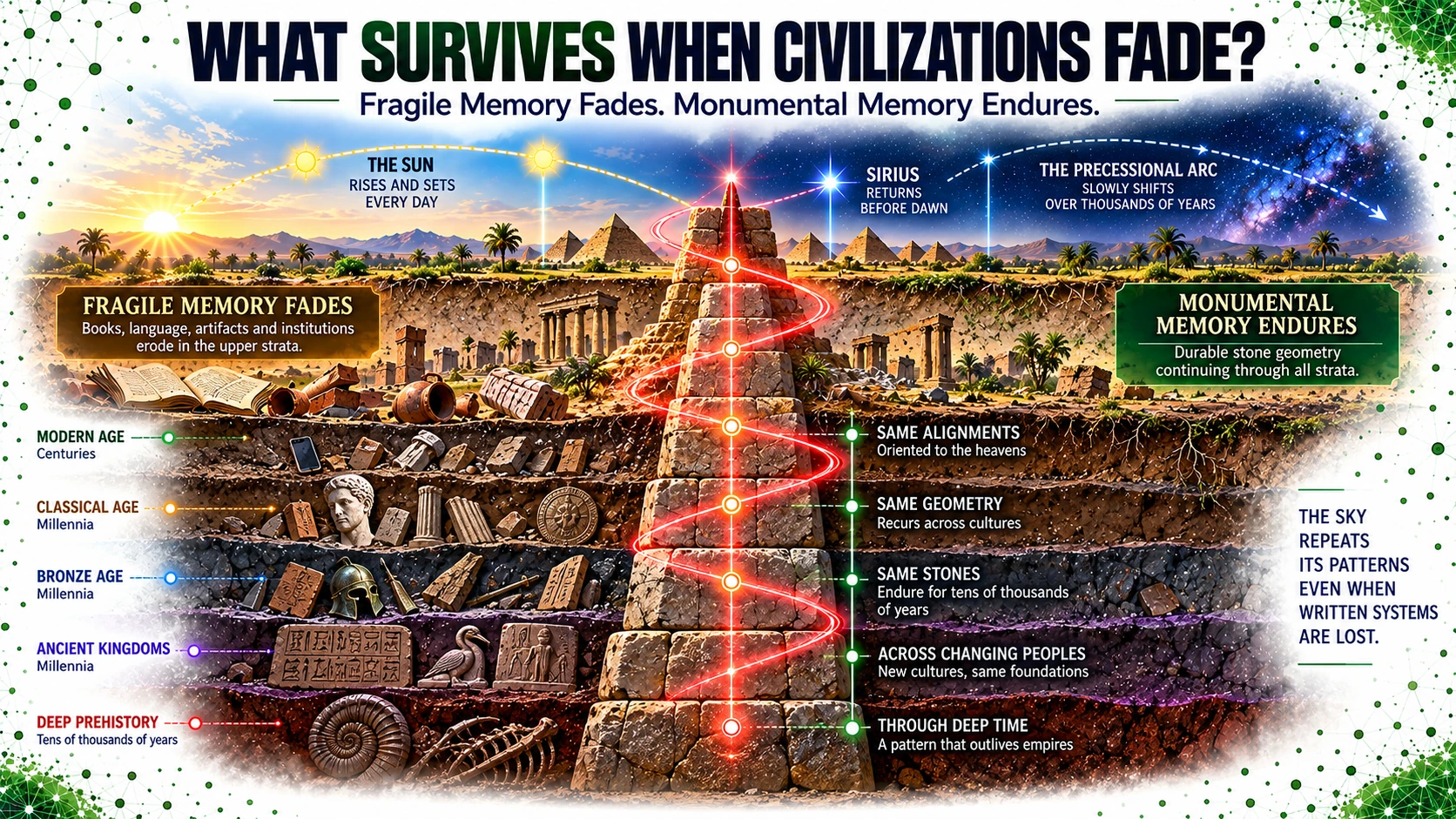
Not a tablet that can be carried away. Not a manuscript dependent on language. Not an institution dependent on political continuity.
A mountain of engineered stone.
That changes the question.
Why choose a medium whose useful lifetime exceeds the civilization that produced it?
The conventional archaeological answers remain essential. Egyptian monumental architecture expressed royal power, funerary belief, cult, cosmic order and the transformation of the king. None of that needs to be discarded.
But permanence itself deserves attention.
A monument may communicate through inscriptions.
A megalithic monument also communicates through its continued existence.
Architecture for Deep Time
“Deep time” is normally a geological idea: a scale so large that an individual human life becomes almost negligible.
Megalithic architecture creates something analogous in culture.
A person dies.
A dynasty ends.
A language changes.
A religion transforms.
The stone remains.
This does not prove that the builders intended to address people thousands of years in the future.
But it establishes something simpler and observable:
the architecture was capable of doing so.
That capacity becomes part of the monument’s historical afterlife.
The Pyramid Is Still Not Fully Known
The Great Pyramid is one of the most studied buildings on Earth.
It still surprises us.
In 2017, the ScanPyramids collaboration reported the detection of a previously unknown large void above the Grand Gallery using cosmic-ray muography. The signal was independently observed with three detector systems. The feature, known as the ScanPyramids Big Void, has a minimum length of about 30 metres. Its purpose remains unknown.
That distinction is crucial:
existence: strongly supported.
function: unknown.
In 2023 a corridor behind the chevron-shaped stones on the north face of the pyramid was directly imaged. In 2025, researchers published a multimodal confirmation using ground-penetrating radar, ultrasonic testing and electrical resistivity tomography.
Four and a half millennia after construction, the architectural map is still being refined.
That fact alone should make us cautious about statements beginning with “we already know exactly what the pyramid is.”
The important point is not that a dramatic secret must exist.
It is almost the opposite.
The unknown can be real without our interpretation of it being correct.
Beneath Giza: Signal Is Not Structure
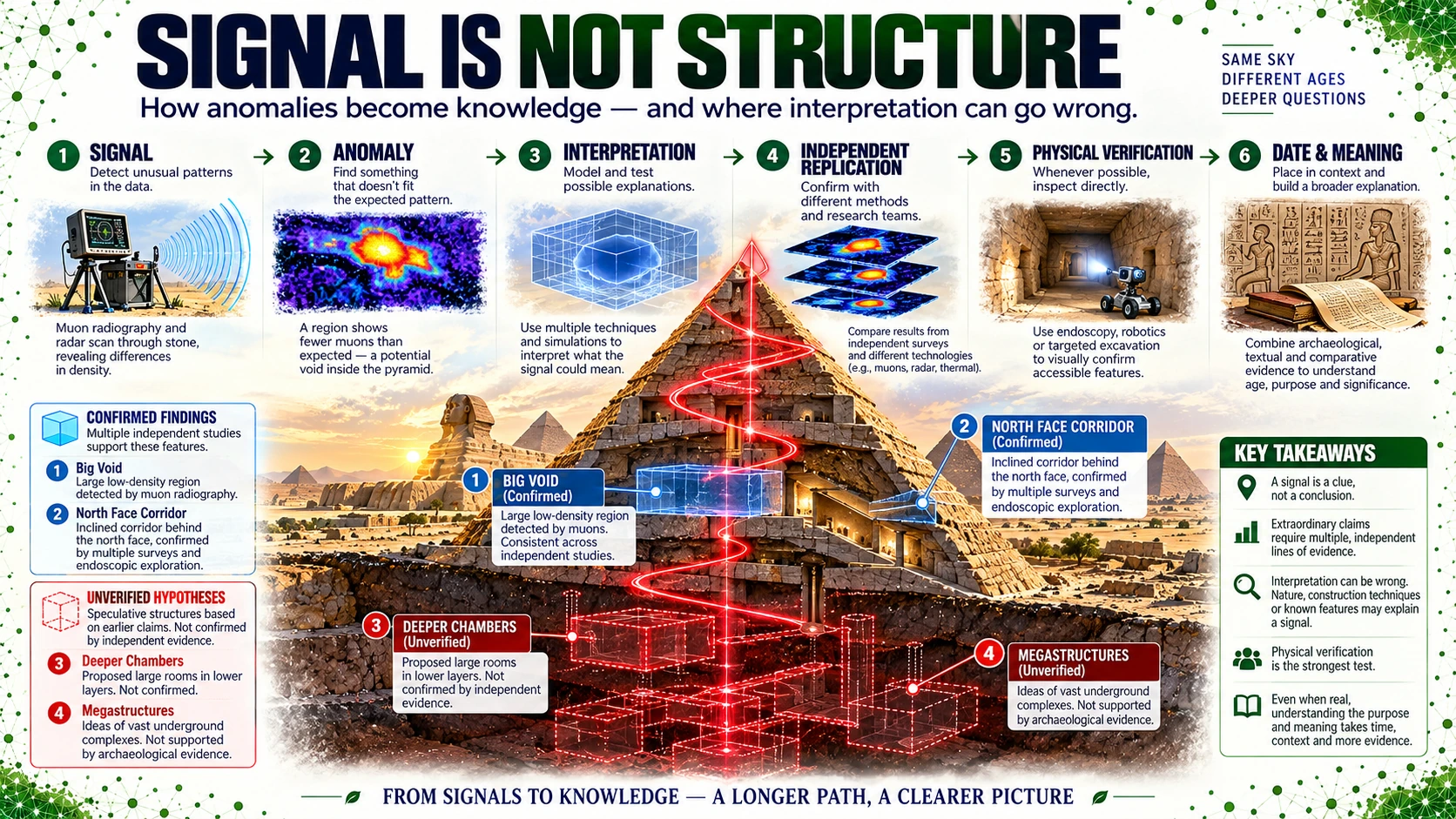
In 2025, dramatic claims spread internationally about enormous structures supposedly detected hundreds of metres beneath the Pyramid of Khafre using a satellite-based interpretation of synthetic aperture radar data.
The published visualizations were extraordinary: deep shafts, cylindrical forms and enormous geometric structures beneath the plateau.
They were also not an archaeological discovery in the established sense.
Radar specialists and Egyptologists challenged the physical ability of the method to resolve structures at the claimed depths, and no excavation or independent geophysical survey has confirmed the proposed underground architecture.
By 2026 the claim remained unverified.
This makes it useful for the article — not as evidence of a lost city, but as a demonstration of how easily a signal can become a story.
This sequence should become one of our rules for the entire investigation:
Signal is not structure. Structure is not date. Date is not meaning.
The temptation is to jump from the first box to the last.
Archaeology exists precisely because we should not.
The Osireion: Architecture Below Time
If Giza confronts us with spaces we are still discovering, Abydos confronts us with something different.
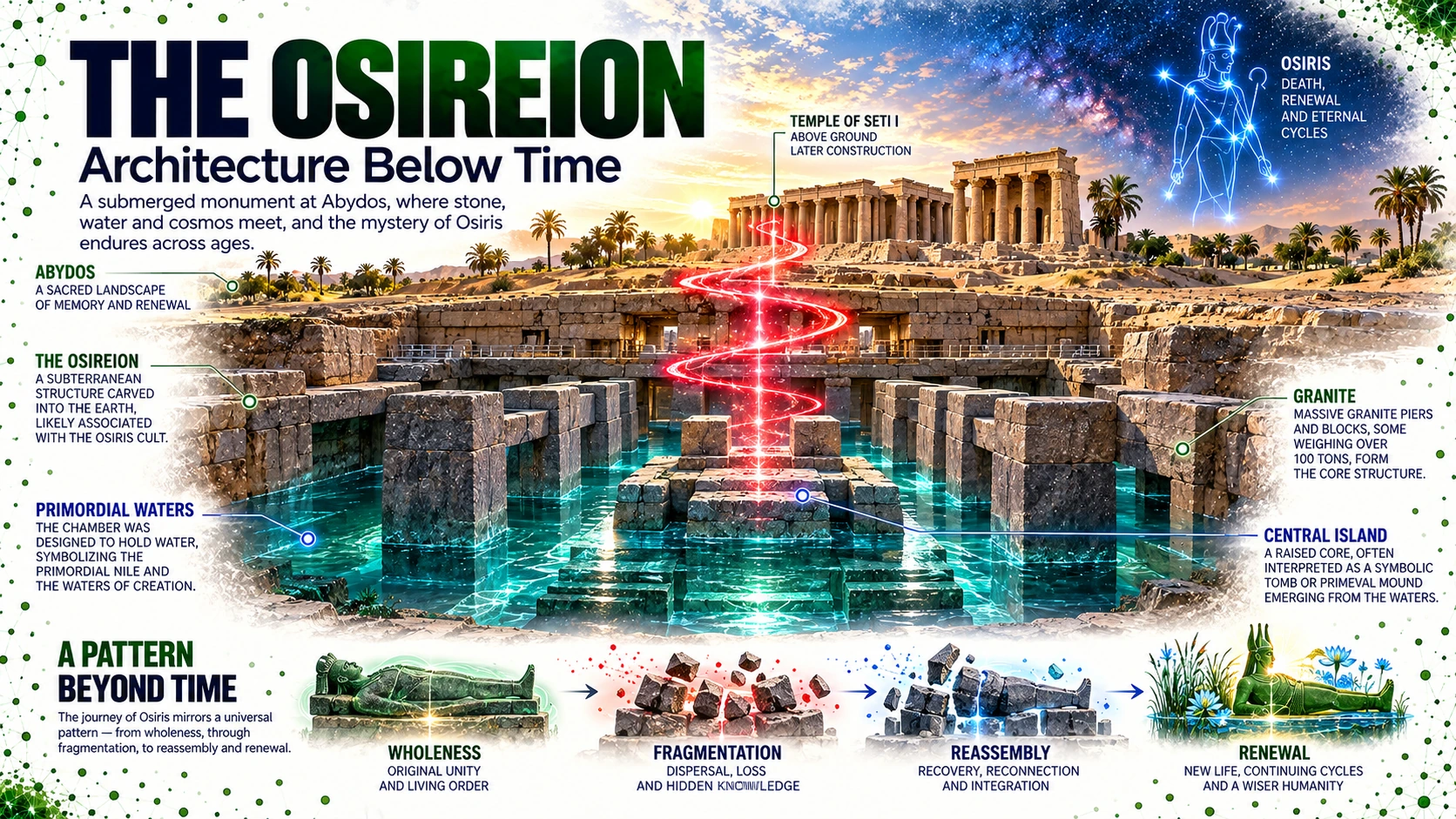
The Osireion, behind the Temple of Seti I, is monumental, subterranean and visually austere. Massive granite elements surround a central architectural core associated with water. Its style feels radically different from the richly decorated temple nearby.
That difference has encouraged modern claims that the structure might be vastly older than Seti I.
The archaeological record does not currently support that conclusion.
Early excavators were themselves struck by the structure. Later work by Henri Frankfort connected the monument structurally and epigraphically with Seti I’s complex. The Egypt Exploration Society describes the Osireion as the enigmatic structure behind Seti’s temple, and the standard interpretation treats it as a cenotaph or symbolic tomb associated with Osiris and the royal funerary program.
The interesting question therefore is not:
Was the Osireion built by Atlantis?
There is no archaeological basis for stating that.
The better question is:
Why did New Kingdom Egyptians deliberately build a structure that evokes an architecture of primordial permanence?
Its subterranean character matters.
Its water symbolism matters.
Its monumental stonework matters.
And Abydos itself matters: by the Middle Kingdom it had become Egypt’s principal cult centre for Osiris.
The structure appears almost designed to make the visitor descend out of ordinary historical time.
Osiris and Reconstruction
There is a philosophical correspondence here worth making explicit — as interpretation, not archaeology.
Osiris is dismembered.
The fragments are gathered.
Order is reconstructed.
Something returns in another form.
The same pattern describes our relationship with ancient civilizations.
The monument survives.
Meaning fragments.
Every later civilization tries to assemble it again.
Hawara and the Memory of the Labyrinth
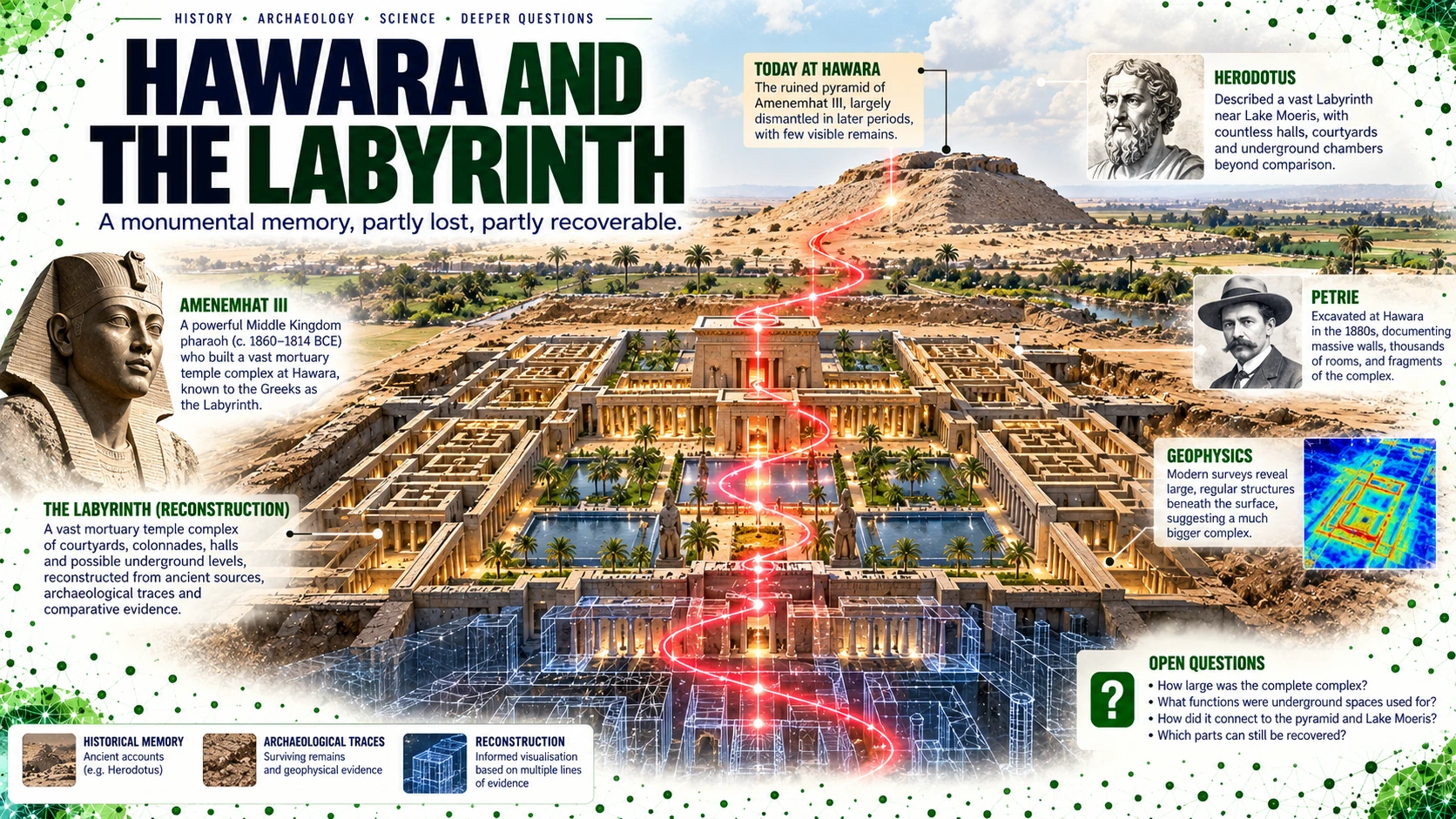
At Hawara, south of the pyramid of Amenemhat III, the situation is almost reversed.
Instead of an enormous monument surviving nearly intact, we have the memory of something extraordinary whose visible architecture was largely destroyed.
Ancient Greek authors described an Egyptian Labyrinth of remarkable scale. Modern archaeology identifies the principal mortuary temple of Amenemhat III at Hawara with that tradition. Petrie excavated the site in the nineteenth century, but found that much of the monumental complex had already been destroyed and quarried.
Yet the site did not become archaeologically empty.
A 2000 survey recovered additional evidence associated with the temple complex. A peer-reviewed 2010 geophysical study reported shallow elongated and square anomalies whose spatial distribution significantly matched aspects of the historical description.
A 2025 paper went further, interpreting satellite SAR imagery as possible evidence for a much larger buried structure.
That latest interpretation should be treated cautiously. Space-based radar claims about deeply buried architecture require independent validation, especially after the controversy surrounding similar claims at Giza.
But Hawara differs from the Khafre story in one important respect:
the Labyrinth is not invented by the modern scan.
Its historical and archaeological existence as Amenemhat III’s temple complex is already well established.
The open questions concern its original form, extent, surviving subsurface remains and how much of the ancient descriptions should be read literally.
The Initiatory Geography Hypothesis
Herodotus places the Labyrinth near Lake Moeris, in the Fayum region, not beneath Giza. The historical Labyrinth and the controversial structures recently claimed beneath the Giza plateau are therefore not the same archaeological claim.
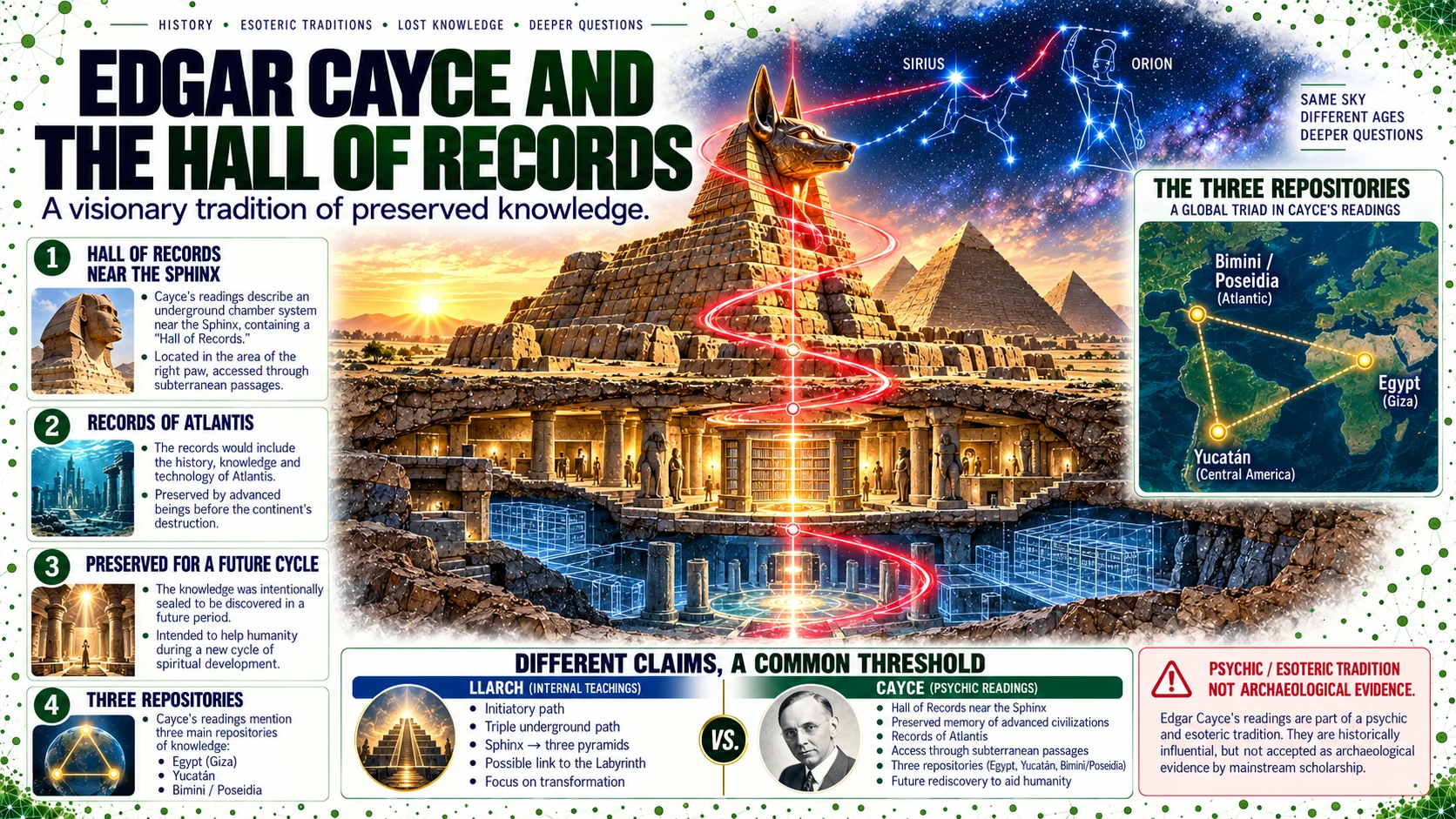
Yet a later initiatory interpretation makes a different connection. In La pirámide iniciática, Joan Llarch asks whether a triple subterranean path could begin at the Sphinx, lead toward the three pyramids and continue toward the Labyrinth described by Herodotus.
This hypothesis directly echoes the reading developed in The Secret of the Sphinx, where the Sphinx is approached as a threshold to an initiatory journey through the Giza complex. Here, however, the question is widened: could that initiatory geography be not only symbolic and ritual, but also reflect a physical organization of space that is now only partially known?
This is not established archaeology, and it should not be presented as a geographical reading of Herodotus. It is better understood as an initiatory geography: the possibility that the Sphinx, the pyramids and the Labyrinth belonged to a larger ritual or symbolic system, whether or not a continuous physical tunnel ever existed.
That distinction allows three different kinds of connection to remain visible:
The physical connection remains unverified. The ritual and symbolic connection, however, can still be examined as an interpretive model: Sphinx as threshold, pyramids as stages of transformation, Labyrinth as ordeal, disorientation and reconstruction.
This does not collapse Hawara into Giza. It asks whether two geographically distinct places could have been understood, in later initiatory readings, as parts of the same sacred map.
Edgar Cayce and the Hall of Records
Joan Llarch imagines an initiatory geography. Edgar Cayce introduces a different kind of possibility: a repository of memory.
The distinction matters. Cayce’s material belongs to a psychic and esoteric tradition, not to archaeology. It should therefore be read as a modern visionary layer in the history of ideas surrounding Giza, rather than as evidence for an undiscovered chamber.
Yet the correspondence with the questions explored here is striking. In Cayce’s readings, the Sphinx becomes a sentinel associated with a sealed repository containing records of Atlantis and of the movements of its people. The Egyptian repository is described as connected with the Sphinx, while related records are also associated with Bimini/Poseidia and Yucatán.
The central idea is not simply that something was hidden. It is that knowledge was supposedly preserved for a later cycle — deliberately placed beyond the lifetime of the civilization that produced it.
That makes Cayce relevant to the theme of architecture for deep time even if his claims remain outside established archaeology:
- Llarch asks whether a path of initiation could connect the Sphinx, the pyramids and the Labyrinth.
- Cayce imagines the Sphinx as guardian of preserved records intended for a future rediscovery.
- Archaeology asks what structures, passages and chronological relationships can actually be demonstrated.
All three approaches meet at the same threshold, but they are making different kinds of claims.
The attached 1968 volume Edgar Cayce on Atlantis, written by Edgar Evans Cayce under the editorship of Hugh Lynn Cayce, organizes the Atlantis material from Cayce’s life readings into a narrative of repeated destructions, migration, reincarnation and civilizational memory. Within that framework, Atlantis is less useful here as a historical conclusion than as a model of knowledge surviving collapse.
This also creates a useful progression across the two posts:
The Secret of the Sphinx — the Sphinx as threshold to a transformative journey.
Llarch — the threshold extended into an initiatory geography.
Cayce — the threshold extended into a repository of memory for another age.
The question therefore becomes broader than whether a literal Hall of Records exists:
What would a civilization choose to preserve if it believed its own world might not survive?
Before Egypt Was Egypt
The pyramids did not emerge from a cultural vacuum.
Predynastic Egypt extends thousands of years before the Fourth Dynasty, and archaeological material shows that the broader Giza area saw human activity before the construction of the great pyramids.
This matters because it changes a misleading binary:
either
Egypt invented everything suddenly

or
a lost civilization built Egypt
History does not require either extreme.
Knowledge can accumulate.
Techniques can be inherited.
Ritual forms can become monumental.
Older landscapes can acquire new meanings.
The more productive question is therefore:
How much of monumental Egypt was invention, and how much was culmination?
That question leaves room for continuity without requiring an unknown civilization.
It also leaves room for genuine surprise.
Archaeology repeatedly shows that what appears sudden at one scale can reveal long development when the scale is widened.
Atlantis: Answer or Archetype?
Atlantis should enter this discussion carefully.
Plato’s Atlantis is one of the most influential stories of a civilization destroyed by catastrophe. Through later interpretation it became a cultural container for a recurring human possibility:
a civilization before our civilization.
There is no accepted archaeological evidence showing that Atlantis built the Egyptian pyramids, the Osireion or the monuments of Giza.
So Atlantis should not be used here as an answer.
It is more useful as an archetype.
It asks what happens when:
- knowledge outlives its institutions;
- memory becomes myth;
- landscapes are transformed;
- civilizations inherit fragments whose origins they no longer fully know.
In that sense, the Atlantis question becomes larger than Atlantis itself.
Can knowledge cross a civilizational rupture without preserving the civilization that produced it?
Cayce’s Atlantis: cycles, migration and preserved memory
Cayce’s Atlantis material pushes that question to its extreme. In the readings as collected and interpreted by Edgar Evans Cayce, Atlantis passes through multiple periods of disruption before a final destruction, while groups disperse toward other regions. The material associates those migrations with Egypt and the Americas and repeatedly returns to a moral contrast between knowledge used for integration and knowledge used for domination.
None of this establishes Atlantis archaeologically. But within the intellectual architecture of this post it adds a revealing motif: civilization can disappear while fragments of its knowledge, symbols and moral warnings continue elsewhere.
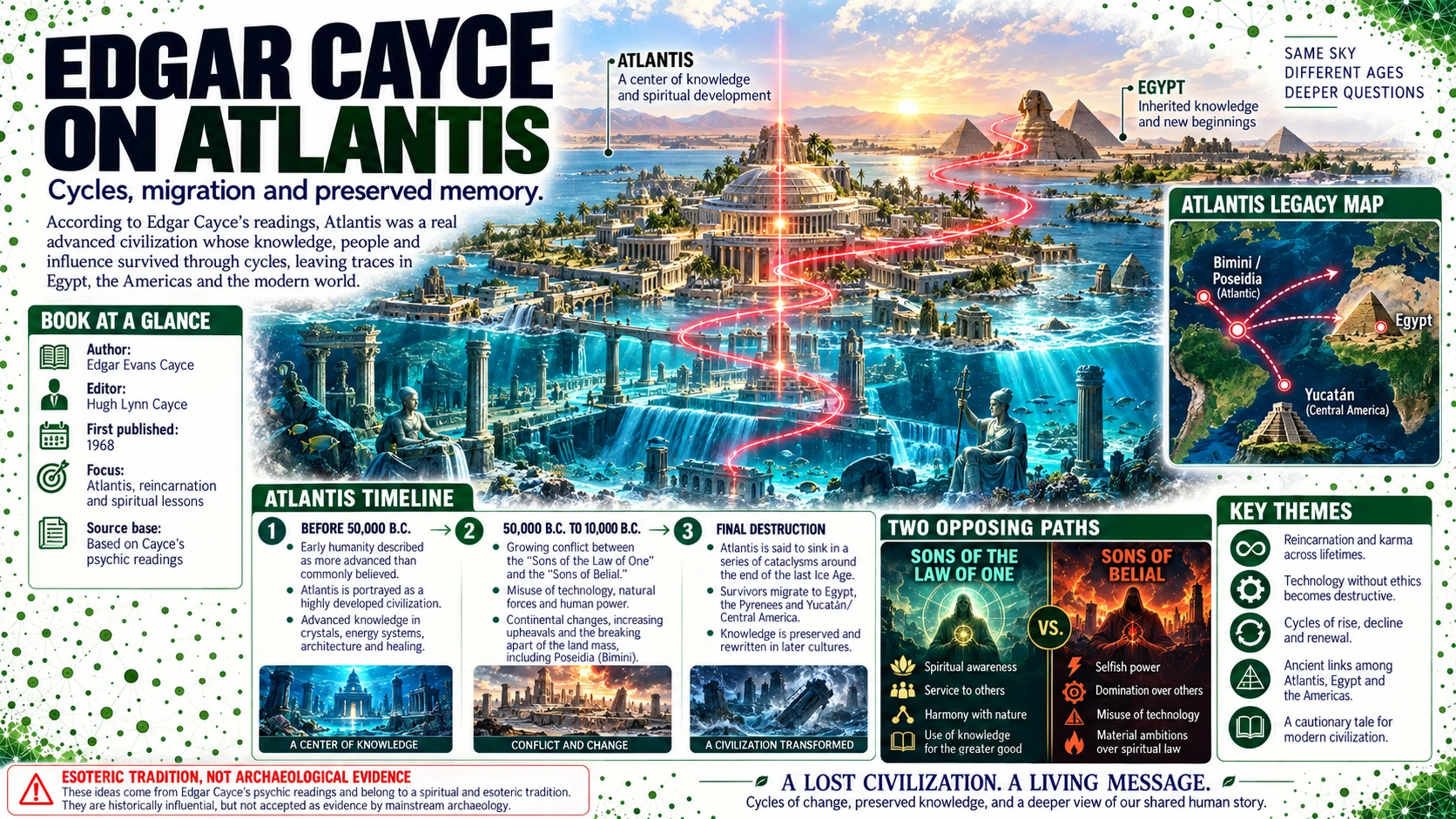
Read this way, Cayce does not provide the answer to Egypt’s origins. He provides another modern expression of the same deep-time anxiety that surrounds megalithic monuments: the possibility that a civilization could try to send something through a rupture larger than itself.
Now the megalith returns to the centre of the story.
Built to Cross Ages
Imagine designing information for an audience you will never meet.
Language is unstable.
Political institutions are unstable.
Religions change.
Organic media decay.
Digital media, as our own civilization is beginning to discover, depend on extraordinarily fragile layers of infrastructure.
Stone is different.
Geometry is different.
The sky is different.
Together they form three unusually durable media.
Again, this is not evidence that the pyramids were intentionally designed as messages to a post-catastrophe civilization.
It is an observation about the medium.
A geometric relationship remains measurable even after the language used to describe it has disappeared.
A cardinal direction remains.
A celestial cycle can be rediscovered.
A stone can remain where it was placed.
This may be one reason monumental architecture so easily becomes a vessel for memory.
The monument as compressed civilization
A megalithic complex may contain, simultaneously:
engineering
geometry
astronomy
ritual
politics
labor organization
myth
landscape
religion
material science
The civilization disappears.
The monument remains as a compressed object.
Archaeology attempts to decompress it.
That metaphor is particularly useful because decompression is never guaranteed to recover the original file perfectly.
Some information survives.
Some correlations survive without explanation.
Some meaning is irretrievably lost.
And some of what we reconstruct may belong more to us than to the builders.
Time as the Audience
This leads to the question that separates this article from The Secret of the Sphinx.
That article asked about a possible legacy.
This one asks why the architecture itself seems so compatible with extreme duration.
Maybe permanence was simply the natural result of religious and royal ambition.
Maybe the purpose was to maintain cult, kingship and cosmic order indefinitely.
Maybe the monument was intended for the gods rather than for distant human observers.
These possibilities are historically grounded and should come first.
But once a structure survives thousands of years, something strange happens.
Its audience changes.
The builders are gone.
The ritual specialists are gone.
The original spoken explanations are gone.
The monument begins speaking to people who were never part of its culture.
At that point, time itself becomes part of the monument’s meaning.
Not necessarily because its builders consciously chose us.
But because they chose a form capable of reaching us.
What Have We Not Yet Learned to Read?
Modern archaeology has extraordinary instruments.
Muon detectors can reveal density anomalies through hundreds of metres of stone.
Radar can image shallow subsurface contrasts.
Electrical methods can infer resistivity.
Ultrasound can reveal internal structure.
Photogrammetry can preserve surfaces at extraordinary resolution.
AI can correlate datasets at scales that were impractical only a generation ago.
Yet better instruments do not automatically create better interpretation.
The hardest part remains the transition:
measurement
      ↓
structure
      ↓
date
      ↓
function
      ↓
meaning
The first stages increasingly belong to physics and engineering.
The last stages still require history, archaeology, language, comparative evidence and intellectual restraint.
Perhaps that is why Egypt remains so compelling.
We possess technologies the builders could never have imagined, yet the monuments can still place us in the position of beginners.
The message may not be hidden
We often imagine that the great discovery must be behind a wall.
Another chamber.
Another shaft.
Another room.
Another text.
Perhaps one day such a discovery will transform what we know.
But there is another possibility.
Perhaps the information is not hidden inside the monument. Perhaps the monument itself is the information.
Its material.
Its orientation.
Its relationship to landscape.
Its scale.
Its internal sequence.
Its relationship to death and regeneration.
Its resistance to time.
Its continued ability to generate questions.
The deepest unsolved problem may therefore not be another chamber beneath Egypt.
It may be the reading system required to understand what has been visible all along.
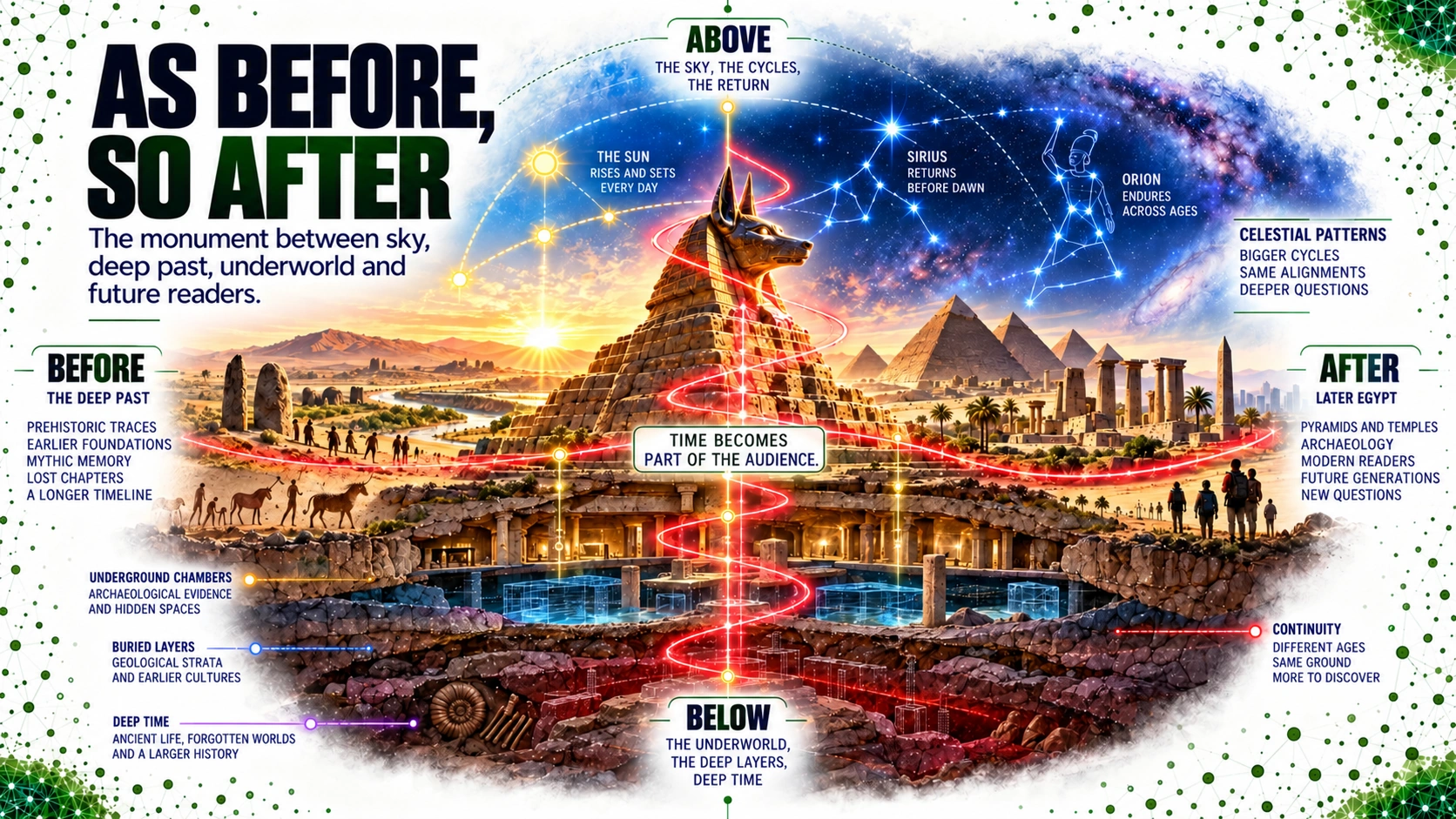
As Before, So After
The previous article used the old symbolic movement:
As Above, So Below.
This investigation suggests another axis.
As Before, So After.
The monument stands at the intersection.
Above and below.
Before and after.
Material and meaning.
Evidence and interpretation.
It survives precisely where these opposites meet.
And perhaps that is what makes megalithic Egypt so difficult to exhaust intellectually.
We assume the mystery is how the stones were moved.
That question matters.
But the stones also force another one.
Why choose a form that could remain after almost everything else was gone?
We may discover more chambers.
We may reconstruct more of Hawara.
We may understand the Osireion more completely.
We may find that some spectacular modern claims disappear under better measurement while quieter discoveries transform the field.
But the deepest question may survive all of them.
Why build as if time itself were part of the audience?
And perhaps the greatest discovery still waiting beneath Egypt is not another chamber.
It is learning how to read the monument.
References and Further Reading
- Morishima et al. — Discovery of a big void in Khufu’s Pyramid by observation of cosmic-ray muons, Nature (2017)
- Schumacher et al. — Confirmation of the ScanPyramids North Face Corridor using multimodal image fusion, Scientific Reports (2025)
- Investigation of the North Face Corridor using Electrical Resistivity Tomography, Scientific Reports (2025)
- AFP Fact Check — Scientists challenge claims of giant structures beneath the Egyptian pyramids (2025)
- National Geographic — Is there really a secret city under Egypt’s Giza pyramids? (2025)
- Egypt Exploration Society — The cemeteries and temples of Abydos
- The Petrie Project — The Osireion at Abydos (1904)
- UCL Digital Egypt — Abydos in the Middle Kingdom
- UCL Digital Egypt — Hawara
- UCL Petrie Museum — Hawara excavation and rediscovery
- Uytterhoeven & Blom-Böer — New Light on the Egyptian Labyrinth: Evidence from a Survey at Hawara, Journal of Egyptian Archaeology (2002)
- Khalil et al. — VLF-EM study for archaeological investigation of the labyrinth mortuary temple complex at Hawara, Near Surface Geophysics (2010)
- Carlotto — Space-Based Ground Penetrating Radar Imaging of a Possible Underground Structure at Hawara (2025)
- Joan Llarch — La pirámide iniciática (official book page)
- Edgar Evans Cayce — Edgar Cayce on Atlantis, under the editorship of Hugh Lynn Cayce, Paperback Library / Association for Research and Enlightenment (1968).
- Edgar Cayce’s A.R.E. — Ancient Mysteries: Atlantis and the Hall of Records
- Edgar Cayce’s A.R.E. — Research into Cayce’s “Hall of Records”
- Edgar Cayce’s A.R.E. — Egypt 10,500 B.C. and the Hall of Records
- The Secret of the Sphinx — Cosmic Cycles and a Legacy for Future Humanity