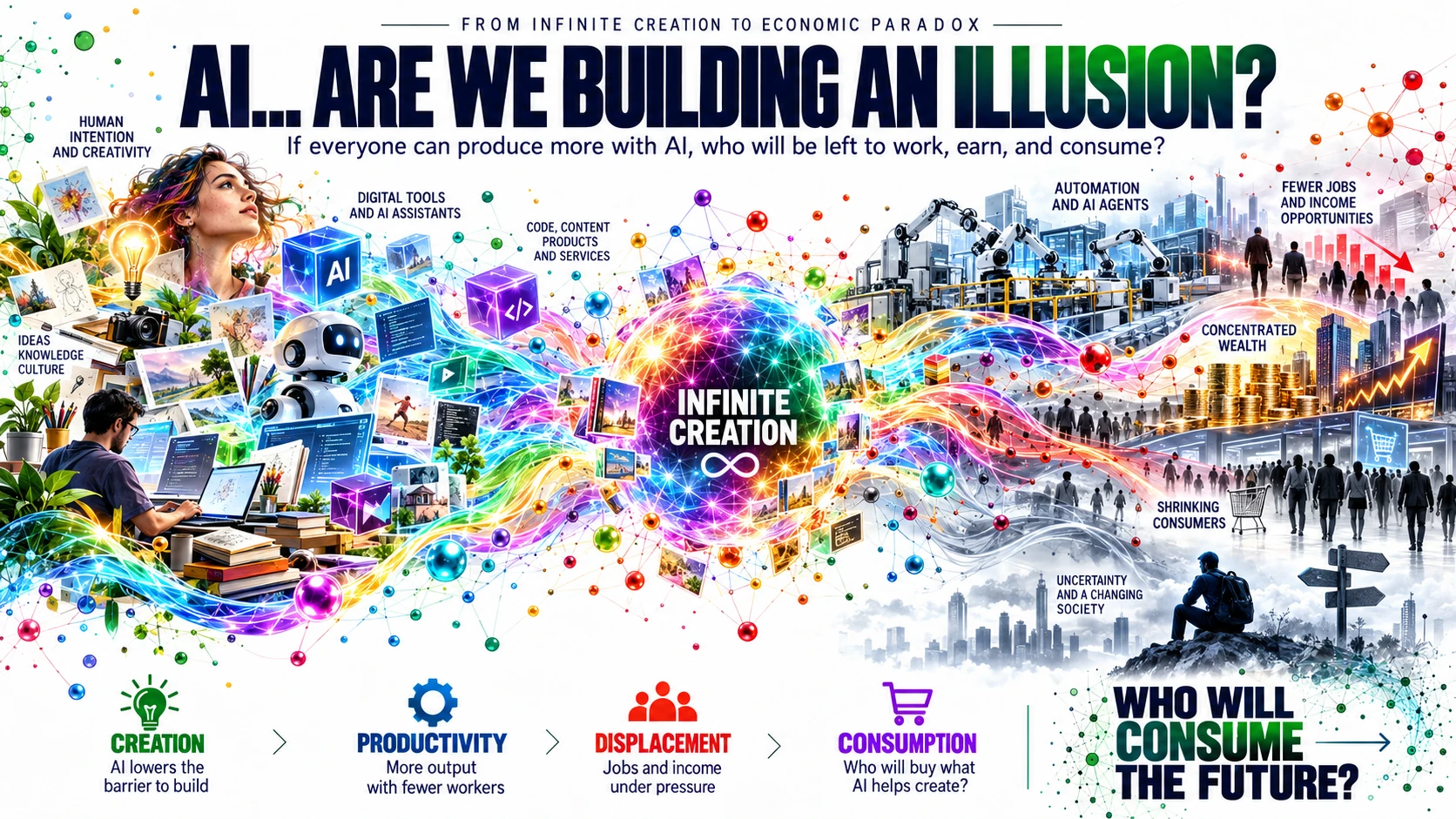
What happens when everyone can create more—but fewer people can earn a living from creating?
AI can help one person build software, write a book, launch a course or automate a workflow. That’s extraordinary. But productivity and prosperity are not synonyms. And being able to make something is not the same as someone needing it.
Perhaps the AI bubble is not only about prices or investment. Perhaps it is also about a story we tell ourselves: if everyone can become a producer, everyone can become successful.
Contents
- Everyone can create. Who will consume?
- When the formula becomes the product
- Can intention itself be an illusion?
- My productivity paradox
- If work disappears, what happens to income?
- What really deserves to exist?
- Further reading
Everyone can create. Who will consume?
Think about what an AI-assisted creator can do today: sketch a business concept, generate a prototype, write marketing copy, produce illustrations and publish a digital product—sometimes in a single workflow.
Now imagine millions of people doing the same thing.
Creation is becoming easier. Attention, trust, time and purchasing power remain scarce. Some AI-enabled products will meet real needs. Others will compete for an audience that was never large enough to support all of them.
Three different tests of creation
Capability — Can I make it?
AI can lower the effort required to produce software, writing, illustrations and other artifacts.
Value — Does it meet a need?
A working artifact still needs a real problem, people who benefit and reasons to trust it.
Demand — Can people support it?
Attention, time and purchasing power constrain what an audience can adopt or pay for.
This is not an argument against creating. It is an argument against confusing the possibility of production with the existence of value.
When the formula becomes the product
There’s a familiar business pattern. Someone succeeds with a particular method. Competitors arrive, margins narrow, and the original opportunity becomes harder to repeat. Eventually, teaching the method can become more profitable than using it.
AI gives this pattern new scale: courses about creating courses, agents that sell other agents, toolkits for building toolkits, and endless promises of financial independence.
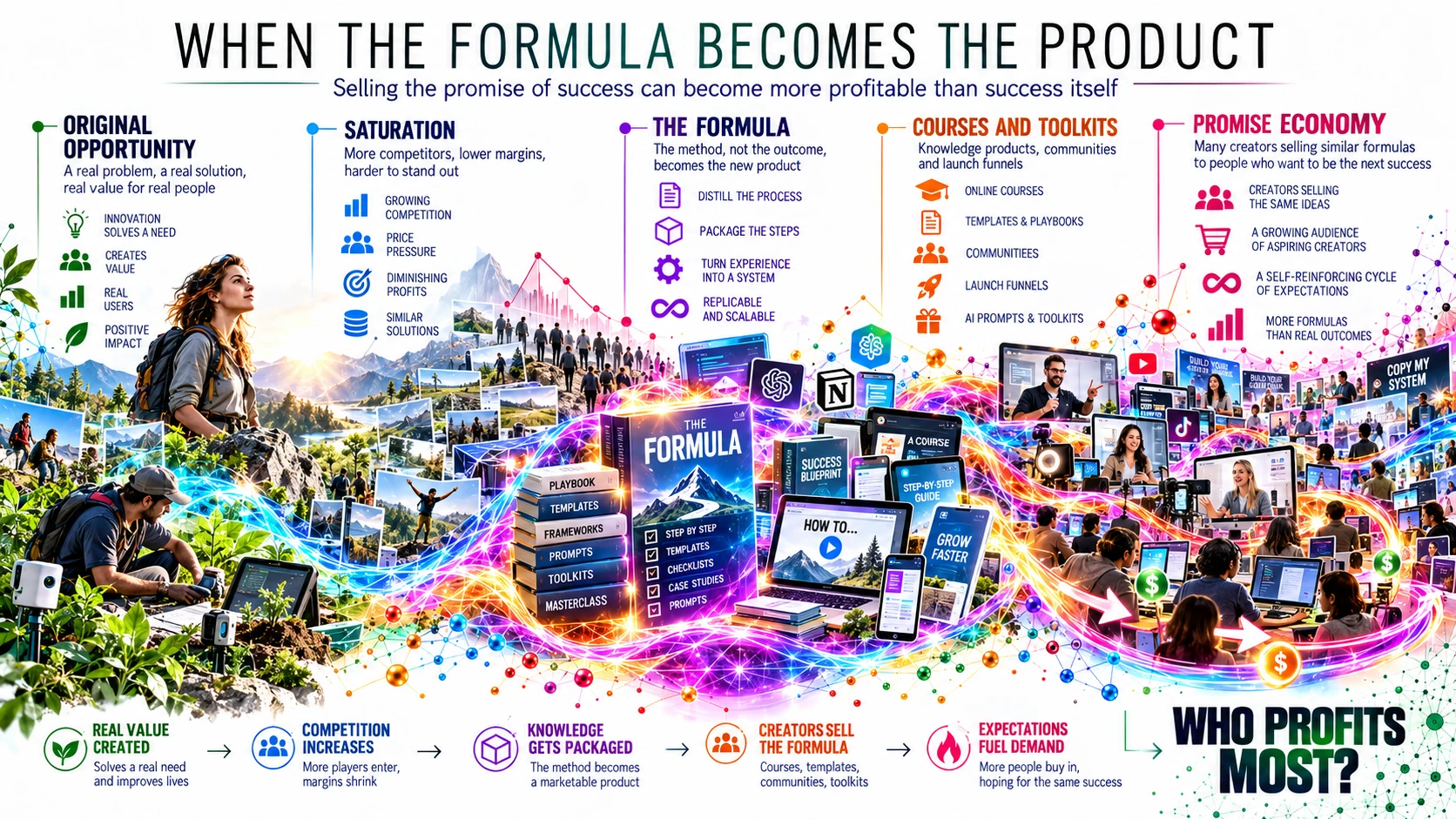
Some of these resources are genuinely valuable. Teaching, documentation and reusable tools are legitimate businesses. The illusion begins when selling the promise of success becomes disconnected from evidence that buyers actually succeed.
Who profits when everyone is encouraged to sell to the next aspiring creator?
Can intention itself be an illusion?
Let’s go deeper. We often celebrate intention as the beginning of creation. But where does intention come from?
A practical need? Curiosity? Care for someone? Or dissatisfaction—the feeling that something is missing and must be obtained?
The work of Jiddu Krishnamurti invites inquiry into desire, comparison, fear and the psychological pursuit of fulfillment. Inspired by that inquiry, consider a possible cycle:
Fold / unfold: intention cycle diagram

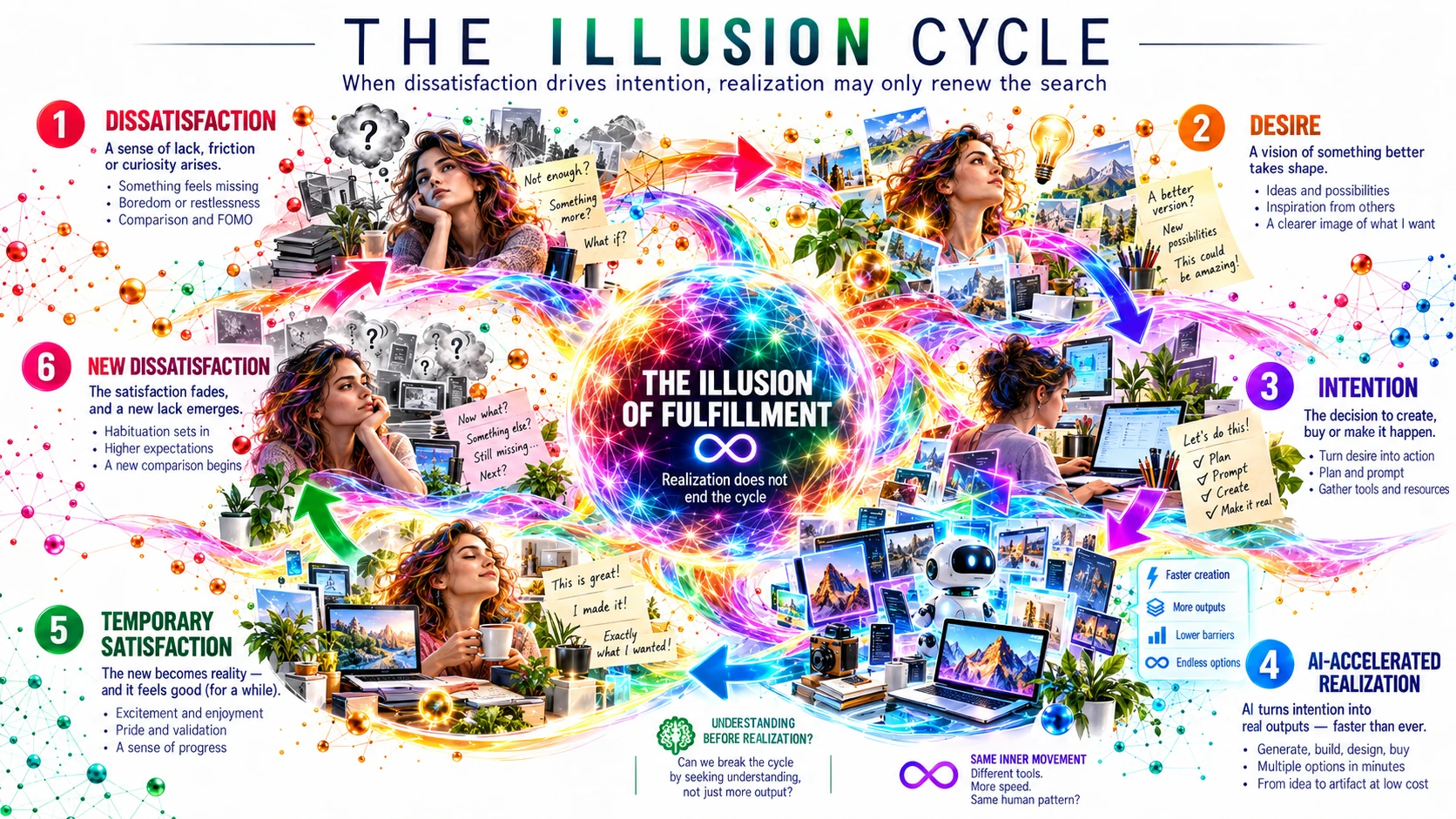
If the intention is rooted in an illusion, realizing it does not necessarily resolve the illusion. It may simply give it a concrete form.
Before asking what we can create, shouldn’t we understand why we want to create it?
This does not make all desire or ambition suspect. Building shelter, caring for someone, solving an engineering problem or creating art can be meaningful actions. The question is whether our motives and expectations are understood—or merely accelerated.
My productivity paradox
This isn’t purely theoretical for me.
In my own AI-assisted software projects, I’ve seen extraordinary development activity. Looking at my GitHub contribution graph, I estimated an average of roughly 40 contributions per day, with an occasional peak of around 600—possibly when my FACTORIES were migrated from Python to Ruby.
Those are personal estimates, not audited productivity figures. GitHub contributions can count commits and other activities; they do not directly measure quality, effort, business value or the amount of work AI performed.
But the experience matters. I can explore, prototype and evolve software much faster than I once could. At the same time, I want to return to work—and finding an opportunity has become difficult.
That contrast is unsettling. If engineers can accomplish more with AI, will companies expand what they build and hire more people? Or will they simply maintain the same output with smaller teams?
Both are possible. The outcome depends on costs, demand, management decisions, new products and the wider economy. My contribution graph cannot establish a causal relationship between AI and hiring. It does, however, make the question personal:
If work disappears, what happens to income?
Imagine a company needing ten engineers to deliver a service. With improved tools, it might deliver the same service with five. The example is hypothetical, not a prediction about engineering headcount.
The freed capacity could create new products and jobs, shorten working hours or reduce prices. It could also become higher profits with fewer vacancies.
The same productivity gain, three perspectives
Firm
Delivering the same service with fewer engineers could lower costs. The firm could expand its products, reduce prices or retain the savings.
Worker
Greater capability can coexist with fewer vacancies. Income, meaningful participation and dignity remain immediate needs.
Society
The distribution of gains matters: productive capacity and purchasing power may diverge. New demand, changes in work and public policy can shape the outcome.
These perspectives describe the same hypothetical change. They can coexist; none establishes what will happen across the economy.
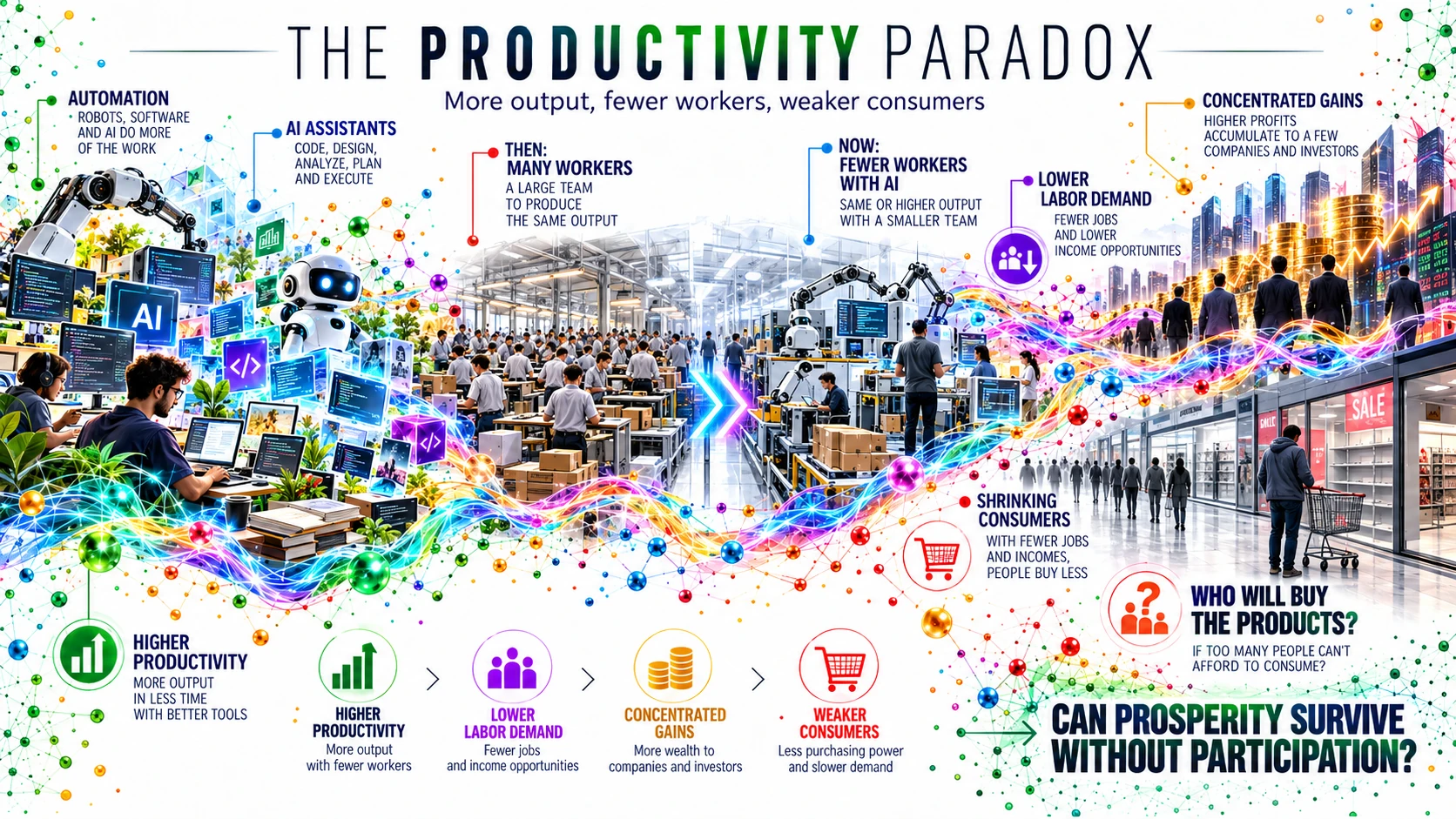
Here’s the tension: we are developing technology that may make some human labor less necessary while keeping people’s survival deeply dependent on paid work.
If gains are concentrated while jobs and wages weaken, purchasing power may fail to keep pace with productive capacity. Who will buy what increasingly efficient firms make?
That is not proof of inevitable economic collapse. Real economies adjust through prices, investment, new services, changes in work and public policy. But adjustment is not automatically fair—and the transition can be painful for people who need work now, not after a future economy takes shape.
The IMF has discussed both AI’s productivity potential and its labor-market and inequality risks. The ILO also emphasizes that exposure to generative AI does not automatically mean jobs disappear. Tasks, occupations and sectors can change in different ways.
The question is no longer just how much more can we produce? It is also who gets to participate in the wealth we produce?
What really deserves to exist?
We began with intention. Then came creation, productivity, markets and the illusion of unlimited success.
Perhaps a better starting point is understanding: the reality of a need, the evidence for a problem, the people affected and the consequences of what we make.
And the same applies to society. We might need new ways to share productivity gains: shorter working hours, improved access to essential services, education, social protections and wider participation in the benefits of technology. These are choices to examine—not outcomes that AI itself will deliver.
For someone searching for work, this is more than philosophy. Meaningful participation, income and dignity are present needs. They cannot be deferred until we figure out the perfect future of automation.
So perhaps the question is not what can AI help us create next?
It is this:
Are we building a future of shared prosperity—or becoming more efficient at realizing a collective illusion?
Further reading
- International Labour Organization — Generative AI and Jobs: A 2025 Update. Research on occupational exposure and potential transformation; exposure is not identical to job loss.
- International Monetary Fund — AI Will Transform the Global Economy. Economic opportunities, employment exposure and inequality concerns.
- Krishnamurti Foundation — Official resources. Primary material for investigating desire, psychological dissatisfaction and understanding; the cycle shown here is this article’s interpretation.
- GitHub Docs — Viewing contributions on your profile. Explains what GitHub counts as a contribution.
Editorial note: economic pathways shown in the figures are possible scenarios, not historical data or quantified forecasts. Personal GitHub estimates are self-reported and should not be mistaken for a benchmark.